



Ashwagandha for Hair Loss & Skin: Does It Work?
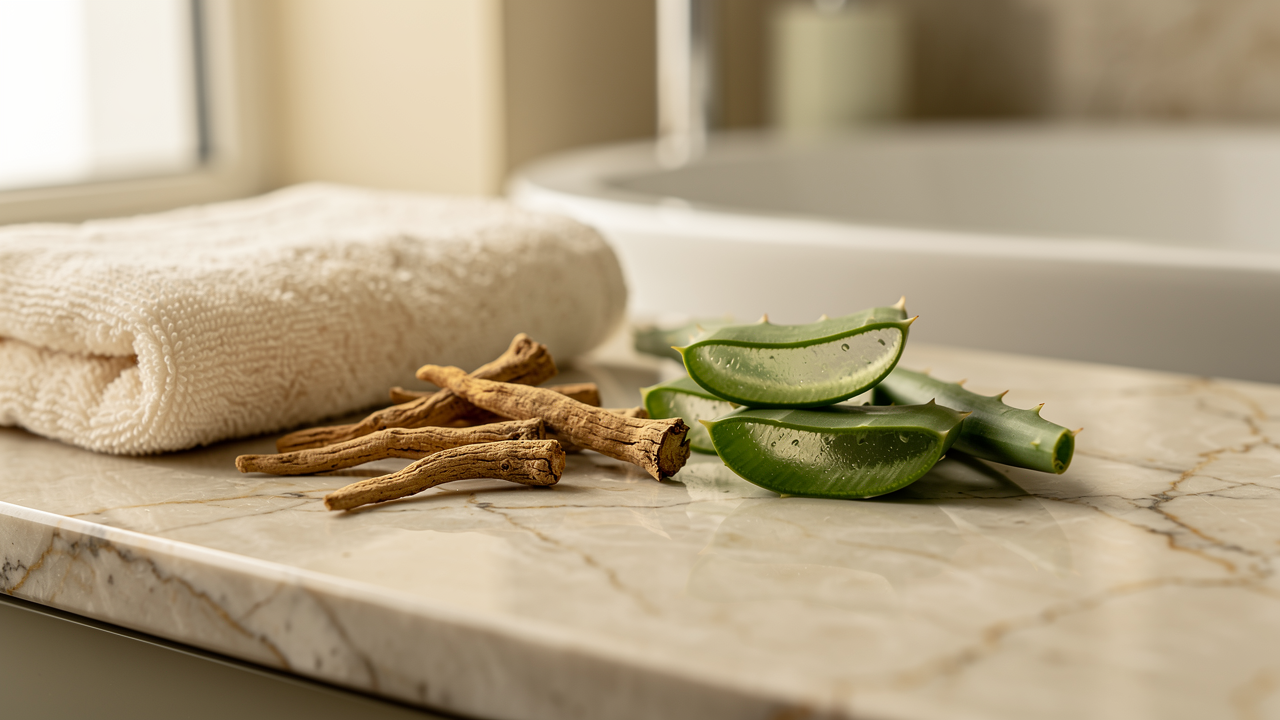
Ashwagandha for hair and skin is a topic where the gap between marketing claims and preliminary research is wider than in most other health areas. The marketing version: ashwagandha is traditionally used to support general wellbeing, including aspects related to hair and skin. The evidence version: considerably more nuanced.
What the research does support is a mechanism that connects to hair and skin quality — and it is the same mechanism that underpins ashwagandha's traditional uses. We call it the cortisol-tissue cascade: a pathway traditionally associated with stress physiology, where chronic cortisol elevation is the subject of ongoing research into its potential influence on collagen metabolism, hair cycle regulation, and skin ageing processes.
Ashwagandha does not directly target hair follicles or skin cells with any unique action. It has been traditionally used to support stress response, which may be associated with general wellbeing, and is the subject of ongoing research.
How Cortisol Damages Hair and Skin
The cortisol-tissue cascade operates through documented, specific mechanisms:
Hair Loss (Telogen Effluvium)
Stress hormones may influence the hair growth cycle by potentially affecting the transition between growth and resting phases. This transition occurs naturally as part of the hair renewal process.
Stress markers may be associated with various bodily functions, including those related to hair follicle activity. The relationship between stress physiology and cellular regeneration remains an area of scientific interest.
Skin Ageing and Collagen Degradation
Stress physiology may influence various bodily processes, including those related to extracellular matrix components like collagen and elastin. These naturally degrade over time as part of the ageing process.
Stress physiology may be associated with skin barrier function through various pathways. The skin's natural barrier serves as protection against external elements and assists in maintaining moisture balance.
Inflammatory Skin Conditions
Stress physiology shows complex interactions with inflammatory pathways, though the exact mechanisms continue to be studied in scientific literature.
What the Direct Evidence Shows
A 2023 RCT (PMID: 37832082, n=66, 8 weeks, 300mg twice daily) examined the effects of standardised ashwagandha root extract on various outcomes including skin quality markers in participants experiencing chronic stress. The study found improvements in quality-of-life scores and stress hormones — including parameters relevant to skin health — alongside the stress and anxiety outcomes. These findings intersect with our stress and mood article where the cortisol data is discussed in detail.
A 2024 RCT (PMID: 37878284, n=52, 12 weeks, 250mg twice daily) using standardised ashwagandha with piperine found measurable improvements in quality-of-life markers that included physical appearance and skin-related parameters in participants with anxiety and depression, alongside the mood outcomes.
The thyroid connection is also relevant here. A 2023 systematic review (PMID: 37013429) documented ashwagandha's positive effects on thyroid hormone levels. Thyroid dysfunction — particularly hypothyroidism — is a major driver of hair thinning, dry skin, and brittle nails. Improving thyroid function may therefore produce hair and skin improvements through this hormonal pathway.
What Has NOT Been Studied
- No RCT has enrolled participants specifically for hair loss and used ashwagandha as the intervention
- No large-scale trial has measured skin collagen density or elastin content as primary outcomes in ashwagandha research
- No study has compared ashwagandha to established hair loss treatments (minoxidil, finasteride, platelet-rich plasma)
- The preresearch suggests benefits for direct withanolide effects on keratinocytes and hair follicles has not been replicated in human clinical trials
The Hormonal Hair Loss Connection
Hormonal hair loss (androgenetic alopecia) involves DHT (dihydrotestosterone) binding to androgen receptors in hair follicles, which may contribute to miniaturisation over time. Ashwagandha does not appear to meaningfully inhibit 5-alpha reductase (the enzyme that converts testosterone to DHT) — the mechanism targeted by finasteride.
However, the thyroid pathway is relevant for a different type of hormonally-driven hair thinning. If hair loss is partially driven by subclinical hypothyroidism (elevated TSH with low-normal T3/T4), ashwagandha's documented thyroid-improving effects (PMID: 37013429) may address this driver specifically.
Additionally, the relationship between stress physiology and hormone modulation continues to be explored in scientific research, with potential implications for various aspects of wellbeing.
Withanolides and Skin: The Antioxidant Angle
Withanolides, compounds found in ashwagandha, are the subject of ongoing research into their potential interactions with biological systems.
Oxidative stress is a naturally occurring process. Plant compounds like those found in ashwagandha are the subject of ongoing research into their potential effects on skin cell metabolism.
What This Means in Practice
For hair and skin, the honest framework is:
- For stress-related concerns, conventional wisdom suggests addressing lifestyle factors may be beneficial. Ashwagandha has been traditionally used as part of holistic approaches to managing daily stressors and is the subject of ongoing research.
- For skin manifestations associated with stress, comprehensive approaches often address both lifestyle factors and skincare routines, recognising the complex interplay between internal and external influences on skin health.
- Who is unlikely to see significant direct benefit: People with androgenetic alopecia (pattern baldness), non-stress-driven skin conditions, or people whose hair and skin concerns are primarily nutritional or environmental.
- Best combined with: Adequate zinc (cofactor for hair keratinisation and wound healing), vitamin C (collagen synthesis), and adequate dietary protein. Ashwagandha addresses the cortisol driver; micronutrient support addresses the substrate availability for hair and skin tissue.
Teelixir's Formulation: Relevance for Skin and Hair
For skin and hair applications, the antioxidant withanolide fraction, traditionally valued for its role in supporting general wellbeing, is particularly relevant. Our dual extraction (hot water + ethanol) is important here: the fat-soluble withanolides are the subject of ongoing research into their potential interactions with biological systems.
Our certified organic specification eliminates agrochemical residues that could themselves be inflammatory or disruptive to the skin barrier — relevant when the goal is reducing systemic inflammatory load.
Root-only, 10:1 concentrated, ≥2.5% withanolides, ACO certified, Di Tao sourced from India. Full COA transparency. Our Teelixir Organic Ashwagandha Root (10:1) is the same quality specification as the clinical trials discussing withanolide-dependent effects. The cortisol pathway discussed in our immune support article is the same mechanism relevant to skin and hair outcomes.
Should You Take Ashwagandha for Hair or Skin?
| Your Situation | Verdict |
|---|---|
| Stress-related hair shedding (telogen effluvium) | Worth trying — targets the cortisol mechanism directly |
| Stress-triggered skin flares (eczema, acne, rosacea) | Reasonable to try as cortisol-modulating adjunct |
| Subclinical hypothyroidism with hair thinning | May address both — monitor thyroid markers |
| Androgenetic alopecia (male/female pattern baldness) | Unlikely to help the primary mechanism — seek dermatologist advice |
| Sun damage, non-stress-related skin ageing | Insufficient specific evidence — topical approaches more appropriate |
Does ashwagandha help with hair loss?
Is ashwagandha good for alopecia areata?
Does ashwagandha help with grey hair?
How does ashwagandha affect the skin?
How long for ashwagandha to improve hair?
The Bottom Line
Ashwagandha is not a hair or skin supplement in the conventional marketing sense. The cortisol-tissue cascade — the pathway by which chronic stress may influence collagen metabolism, hair cycle regulation, and skin ageing processes — is the mechanism through which ashwagandha has potential relevance.
For people whose hair and skin concerns are substantially driven by chronic stress, ashwagandha has been traditionally used to support general wellbeing, and its potential effects on stress have been explored in some studies.
For stress-independent hair loss or skin concerns, the direct evidence is preliminary at best. Consult a dermatologist and address the primary drivers — whether that is nutrient status, hormonal balance, or DHT-mediated follicle miniaturisation.

Full-Spectrum • Root Only • ACO Certified Organic
Teelixir Organic Ashwagandha Root (10:1)
≥2.5% withanolides. Dual extract (hot water + ethanol). Di Tao sourced from India. Certified organic by ACO. Third-party tested.
View ProductThis product is not intended to diagnose, treat, cure, or prevent any disease. Always consult your healthcare professional before starting any new supplement.
Continue Your Research
- Ashwagandha Benefits: The Complete Evidence-Based Guide
- Ashwagandha Dosage Guide: What Clinical Trials Actually Used
- Ashwagandha Side Effects: The Tolerance Threshold and What 29+ Clinical Trials Reveal
- Ashwagandha for Women: Hormones, Perimenopause, and the Hormonal Seesaw
- Ashwagandha for Thyroid: The Bidirectional Risk Explained
- Ashwagandha for Anxiety and Stress: What 9 RCTs Actually Found
- Ashwagandha for Muscle Strength: The Anabolic Recovery Window Explained
- Ashwagandha for Gut Health: The Stress-Gut Axis Short-Circuit


