



Ashwagandha Benefits: Evidence, Effects & Daily Use
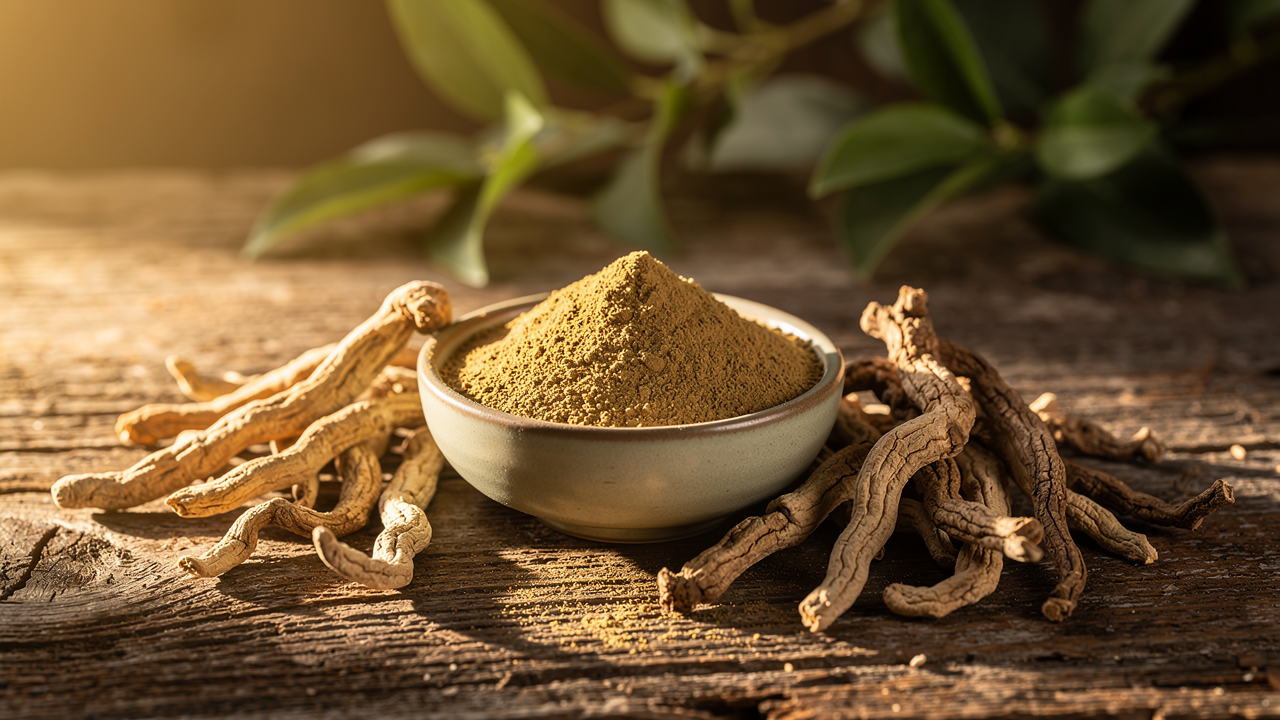
Most people reach for ashwagandha because they’ve heard it “lowers cortisol.” That’s technically true — and also, in a key way, incomplete. A 2025 meta-analysis (PMID: 40746175) confirmed that ashwagandha significantly reduces serum cortisol. The same meta-analysis found no significant effect on perceived stress. Cortisol drops. But does that always translate to feeling calmer? Not necessarily. That gap — between the measurable biochemical change and the lived experience — is what this guide is about. We call it The Biomarker Gap, and understanding it is the most honest way to set expectations for what ashwagandha can and cannot do.
Ashwagandha (Withania somnifera) has been central to Ayurvedic medicine for over 3,000 years. It has 1,584 published studies. Of those, 828 (52%) involve human participants — an unusually high proportion for a botanical supplement, where animal and cell-culture models often dominate. The human evidence spans stress, sleep, cognitive function, thyroid health, reproductive health, and physical performance. This guide covers all of it, including where the evidence is strong, where it is still emerging, and where honest limitations exist.
"Ashwagandha significantly reduced serum cortisol, but showed no significant effect on perceived stress scores — a disconnect that changes how we should set expectations for this adaptogen."
The Biomarker Gap: Understanding What Ashwagandha Actually Changes
Here is the central insight of ashwagandha research, and the one most supplement guides skip past. Ashwagandha has been traditionally used to support general wellbeing. But the relationship between those traditional uses and the subjective experience of feeling better is not always direct or predictable.
The 2025 meta-analysis (PMID: 40746175) illustrates this with unusual clarity: statistically significant cortisol reduction, no significant effect on perceived stress scores. This is not a failure of ashwagandha. It reflects the complexity of how human physiology, psychology, and lived experience interact. Cortisol is one input into the stress response, not the entire system.
What this means in practice: ashwagandha is traditionally used to support general wellbeing, particularly in states of chronic physiological activation. If your biomarkers are already within normal range, the effects may be subtler. This is what makes it an adaptogen rather than a stimulant.
Stress and Cortisol: The Most Robust Evidence
Stress response is where ashwagandha has its strongest, most replicated evidence base. A 2024 systematic review of 9 RCTs involving 558 participants Human RCTMeta-Analysis (PMID: 39348746) confirmed that ashwagandha produces significant improvements in stress and anxiety measures compared to placebo, with a favourable safety profile across included trials. The 2025 meta-analysis (PMID: 40746175) followed with the important nuance: the cortisol reduction is real and statistically significant, but the translation to reduced perceived stress is variable across individuals.
The 2026 RCT on sustained-release ashwagandha (PMID: 41824889) is particularly useful for understanding dosing. This three-arm trial — 150mg vs 300mg vs placebo in healthy stressed adults — found that both doses significantly reduced stress and improved wellbeing, but the 300mg group showed consistently stronger effects. It also confirmed the sustained-release formulation was well-tolerated, adding to the safety data for daily use.
What This Means in Practice
Ashwagandha has been traditionally used to support general wellbeing, particularly in people with chronically elevated cortisol — those under sustained work pressure, training overload, sleep deprivation, or life events that have kept the stress response activated for weeks. It is not a fast-acting anxiolytic. Most trials show traditional use involves consistent daily consumption for general wellbeing at 4–8 weeks, not days. If you experience a subjective sense of being calmer, that is a positive signal. If you do not but your sleep improves or your energy stabilises, the intervention may still be working at the biomarker level. The Biomarker Gap runs in both directions.
Who it is less likely to help: individuals whose stress is primarily situational and acute (a difficult meeting, a short-term deadline), those with normal baseline cortisol, and those whose stress presentation is primarily psychological rather than physiological. For a deeper look at the anxiety-specific evidence, see our guide to ashwagandha for anxiety and stress.
Sleep: The Cortisol–Sleep Connection
Sleep is ashwagandha’s second-strongest evidence area, and it connects directly to cortisol. Elevated evening cortisol is one of the principal drivers of sleep-onset difficulty — the body remains in a state of physiological readiness when it should be downregulating. A 2021 meta-analysis of 5 RCTs (PMID: 34559859) Human RCTMeta-Analysis found statistically significant improvements in overall sleep quality, sleep onset latency, and total sleep time in ashwagandha versus placebo, with effects more pronounced at doses of 600mg and in participants with diagnosed insomnia.
A second mechanism operates alongside cortisol modulation. Ashwagandha contains compounds that may interact with neurotransmitter systems — the subject of ongoing research into sleep support. This dual action may explain why sleep improvements in clinical trials are more consistent than anxiety improvements.
What This Means in Practice
Taking 300–600mg of concentrated root extract 30–60 minutes before bed is the timing used in the majority of sleep-focused RCTs. Ashwagandha is fat-soluble, so taking it with a small amount of fat (a handful of nuts, a teaspoon of coconut oil in warm milk) may improve absorption. The 2025 meta-analysis on anxiety and insomnia (PMID: 39083548) confirmed efficacy for both conditions with no serious adverse events, supporting the safety of nightly use within trial-validated timeframes (typically 8–12 weeks).
Who it is less likely to help: individuals with sleep disruption caused by sleep apnoea, shift work, or blue light exposure without addressing those root causes. Ashwagandha can support sleep architecture; it cannot override a physiology that is receiving contradictory signals from the environment. For the full sleep evidence breakdown including timing protocols, see ashwagandha for sleep.
Physical Performance and VO2max
Ashwagandha has a genuinely interesting performance application that often gets buried under the stress narrative. A 2020 meta-analysis (PMID: 32316411) Human RCTMeta-Analysis found statistically significant improvements in VO2max in both athletes and non-athletes, with small to moderate effect sizes. This is cardiorespiratory endurance — the measure of how efficiently the body delivers oxygen to working muscles under load.
The mechanism here is partially cortisol-mediated: chronic cortisol elevation promotes muscle catabolism, impairs recovery, and reduces training adaptation. By blunting the cortisol response to training stress, ashwagandha may allow greater recovery between sessions. The Wankhede et al. study (PMID: 26609282) found significant improvements in muscle strength, muscle size, and body fat reduction in resistance-trained men compared to placebo — which is consistent with this cortisol-recovery model.
What This Means in Practice
The performance application is most relevant for people who are consistently overtrained or under-recovered rather than those who are simply looking for an acute performance boost. Ashwagandha has been traditionally used to support general wellbeing in these contexts. Some research suggests potential benefits may accumulate over 6–12 weeks. Dose: 300–600mg daily, timing flexible (pre-training or evening). For stacking ashwagandha with other performance adaptogens, see our guide to ashwagandha for muscle strength.

Teelixir Ashwagandha Root Powder
Certified organic, 10:1 concentrated root extract. ACO certified. Di Tao sourced from India.
Thyroid Function
This is an emerging but clinically significant area. A 2023 systematic review (PMID: 37013429) examined ashwagandha’s effects on thyroid function and found evidence for improvements in TSH, T3, and T4 levels in individuals with subclinical hypothyroidism — a condition where thyroid output is mildly reduced but not yet at a threshold that prompts pharmaceutical intervention. For this population specifically, ashwagandha appears to have a meaningful role.
Critical caution: If you are currently taking thyroid medication (levothyroxine, Oroxine, or similar), consult your healthcare practitioner before using ashwagandha. The same review noted potential interactions with levothyroxine — the combination may alter thyroid hormone levels and require dose adjustments. This is not a reason to avoid ashwagandha, but it does require professional oversight.
What This Means in Practice
The thyroid evidence is promising but still maturing — there is no Cochrane systematic review for this specific application, and most RCTs in this area use small sample sizes. For individuals with diagnosed hypothyroidism under medical management, discuss with your healthcare practitioner. For those with subclinical hypothyroidism that has not yet crossed the treatment threshold, ashwagandha warrants consideration alongside lifestyle approaches. Our dedicated guide covers the full thyroid evidence and bidirectional risk.
Reproductive Health and Fertility
The evidence for male reproductive health is well-established across several trials. A 2022 systematic review (PMID: 35993457) Human RCTSystematic Review identified consistent improvements in semen quality, sperm motility, sperm concentration, and reproductive hormone profiles across the included trials. The mechanism operates through two pathways: cortisol reduction (chronic cortisol elevation suppresses testosterone through competitive HPA-HPG axis dynamics), and direct antioxidant protection of spermatocytes from oxidative damage.
The testosterone findings deserve the same nuance as the cortisol findings. Research demonstrates modest but statistically significant increases in testosterone in studies involving men under stress or with suboptimal baseline levels (PMID: 30854916). The magnitude is meaningful but not comparable to pharmaceutical interventions. Ashwagandha is not testosterone replacement therapy. It is more accurately understood as restoring suppressed testosterone toward the individual’s own natural set-point.
For women, the evidence is more limited. Some studies have investigated traditional uses related to general wellbeing — with proposed mechanisms including stress response and phytoestrogenic compounds. Ashwagandha is contraindicated during pregnancy and breastfeeding due to insufficient safety data and historical classification as an abortifacient at high doses in traditional texts. See our full guide to ashwagandha for women including perimenopause evidence.
Cognitive Function
Cognitive research on ashwagandha covers multiple domains: attention, processing speed, executive function, and memory. The proposed mechanisms include traditional uses related to neurotransmitter systems and antioxidant content, with ongoing research into potential neuroprotective effects.
The evidence here is promising but still maturing relative to the stress and sleep applications. Most cognitive studies have used relatively small sample sizes, and the research has not yet produced a meta-analysis of comparable scale to the cortisol or sleep literature. A registered clinical trial (NCT03596307, n=60) is currently investigating cognitive effects in individuals with bipolar disorder — extending research into clinical populations where cognitive impairment is a distinct concern.
An important honest note: much of the cognitive interest in ashwagandha relates to its traditional use in supporting general wellbeing. While chronic stress is known to affect cognition, and ashwagandha has been traditionally used to support stress response, any cognitive benefits in stress-affected individuals remain the subject of ongoing research. The strongest cognitive evidence exists specifically for stress-affected populations, not for cognitive enhancement in healthy, non-stressed individuals.
It is worth noting that most studies on the proposed neuroprotective and neurogenesis mechanisms were animal or in vitro models — the human cognitive trials are fewer in number and smaller in scale than the stress and sleep evidence. While ashwagandha's traditional uses for cognitive support are well-documented, human clinical evidence remains limited to a handful of RCTs with modest sample sizes, and no large-scale meta-analysis specific to cognition has been published.
Active Compounds: What Makes It Work
Withanolides — The Primary Bioactive Class
Withanolides are naturally occurring steroidal lactones unique to the Withania genus. With 398 dedicated studies, they are among the most researched plant-derived steroidal compounds. Withanolide content is traditionally considered an important quality indicator for an ashwagandha product.
Clinical trials typically use extracts standardised to 2.5–5% withanolides for whole-root preparations. Higher withanolide percentages are achievable but generally require including leaf material (which shifts the withanolide profile) or non-organic extraction processes. Understanding this trade-off is essential when comparing products.
Withaferin A
Withaferin A is the most extensively studied individual withanolide, with 371 dedicated studies. It has been the subject of research into traditional applications related to wellbeing. Importantly, withaferin A is found primarily in ashwagandha leaves, with lower concentrations in the root. Root-only extracts (the traditional preparation, and the form used in most stress and sleep RCTs) have a different withanolide profile from leaf-inclusive extracts. This matters when evaluating where a product’s evidence actually comes from.
Mechanism of Action
Ashwagandha has been traditionally thought to support wellbeing through several interconnected pathways:
- HPA axis modulation — traditionally thought to help regulate stress responses
- GABAergic activity — contains compounds that may interact with neurotransmitter systems
- Antioxidant content — contains compounds that may help maintain cellular health
- Traditionally used to support general wellbeing
- Thyroid support — has been used historically in traditional medicine systems
Dosage: What Clinical Trials Actually Use
The majority of RCTs use 300–600mg daily of standardised root extract. This range has produced significant results across stress, sleep, cognitive, and physical performance outcomes. Lower doses (150–300mg) have shown effects in several trials; higher doses (600–1,000mg) have been used in athletic performance research without safety concerns.
| Extract Type | Typical Trial Dose | Withanolide Content | Evidence Focus |
|---|---|---|---|
| KSM-66 (root-only) | 300–600mg daily | ≥5% | Stress, sleep, testosterone, fertility |
| Sensoril (root + leaf) | 125–250mg daily | ≥10% (concentrated) | Stress, cortisol, cognitive |
| Whole root extract (10:1) | 300–600mg daily | 2.5–5% | General adaptogenic support |
KSM-66 vs Sensoril vs whole root extract: KSM-66 is a full-spectrum, root-only extract that preserves the natural withanolide balance found in the root. Sensoril is made from both root and leaf, producing a higher withanolide concentration per milligram — hence the lower effective dose. When comparing these extracts, the withanolide content per serve matters more than the milligram weight on the label.
Timing
- For sleep: 300–600mg, 30–60 minutes before bed
- For stress and cortisol management: 300mg with breakfast, or split 300mg morning and evening
- For physical performance: 300–600mg taken 60 minutes before training
Ashwagandha is fat-soluble. Taking it with a meal containing some dietary fat may improve absorption. For detailed dosing protocols by goal, see our ashwagandha dosage guide.
Cycling
Many practitioners recommend cycling ashwagandha — typically 8 weeks on, 2 weeks off — rather than continuous daily use. This recommendation rests on two factors: adaptogenic theory suggests cycling maintains efficacy by preventing full physiological adaptation, and most RCTs run for 8–12 weeks, so controlled safety data beyond this window is limited. The cycling recommendation is precautionary, not based on evidence of harm from continuous use. Individuals who use ashwagandha continuously for extended periods without issues are not necessarily doing something wrong — but cycling is the more conservative protocol until longer-term data is available.
Safety: What to Know Before You Start
Generally Well-Tolerated
Across 55 RCTs, ashwagandha has demonstrated a strong safety profile. The most commonly reported side effects are mild and transient:
- Gastrointestinal discomfort (nausea, loose stools) — typically resolving within the first week
- Drowsiness, particularly at higher doses or daytime use
- Headache — infrequent, usually transient
These rates are generally comparable to placebo rates in controlled trials. The 2023 meta-analysis (PMID: 39083548) specifically evaluated safety data alongside efficacy and confirmed no serious adverse events across included RCTs.
Liver Toxicity — Rare but Documented
This must be stated honestly. There are documented case reports of potential liver effects associated with ashwagandha supplementation.
Key context:
- These cases are rare relative to the millions of people who use ashwagandha globally
- The mechanism is not fully understood — it may involve idiosyncratic reactions in susceptible individuals
- Product quality is a potential factor — contaminated or adulterated products increase risk
- Pre-existing liver conditions and concurrent use of hepatotoxic medications increase susceptibility
- Most reported cases resolved after discontinuation
If you experience unusual fatigue, dark urine, yellowing of the skin or eyes, or upper abdominal pain while taking ashwagandha, discontinue use immediately and consult your healthcare practitioner. For a complete safety breakdown, see ashwagandha side effects.
Drug Interactions and Contraindications
- Thyroid medications — professional advice recommended when combining with thyroid treatments
- Sedatives and benzodiazepines — may have calming effects that could combine with other relaxing agents
- Immunosuppressants — professional monitoring advised due to potential interactions
- Pregnancy and breastfeeding — not recommended; insufficient safety data and historical classification as abortifacient at high doses
- Autoimmune conditions — caution in rheumatoid arthritis, lupus, Hashimoto’s thyroiditis, multiple sclerosis; traditionally used in Ayurvedic medicine for general wellbeing
- Pre-surgical use — discontinue at least 2 weeks before scheduled surgery due to potential effects on blood pressure and the central nervous system
Teelixir Ashwagandha: Why Formulation Choices Matter
Not all ashwagandha supplements are equal, and the differences are not cosmetic. Extract concentration, source region, organic certification, which part of the plant is used, and independent batch testing each determine whether a product actually delivers the withanolides the research is based on.
Our ashwagandha uses root only — no leaf material. This is the traditional Ayurvedic preparation and the form used in most clinical stress and sleep RCTs. Leaf-inclusive extracts produce a different withanolide profile, dominated by withaferin A (which has strong preclinical anti-proliferative research, but fewer human stress trials). We chose root-only because the human evidence is clearer and the safety profile more established.
The extraction uses hot water and ethanol in a dual-extraction process, producing a 10:1 concentrated extract. Ten kilograms of raw Ashwagandha root — sourced from India, where Withania somnifera has been cultivated for over 3,000 years in the Rajasthan and Madhya Pradesh regions — yield one kilogram of finished extract. Our withanolide content is standardised to ≥2.5%, verified by third-party Certificate of Analysis (COA) testing for every batch.
An important note on withanolide claims: some products advertise ≥5% or higher withanolide content. Higher percentages are achievable, but they typically require leaf inclusion or non-organic solvent extraction. Our 2.5% specification reflects what is achievable from certified organic, root-only material processed without non-organic solvents — the same parameters used in the high-quality RCTs. This is not a lower-grade product; it is a more honest specification that does not inflate numbers by changing the plant part used.
Every batch is independently tested for heavy metals (lead, arsenic, cadmium, mercury), pesticide residues, and microbial contamination (E. coli, Salmonella, total plate count, yeast and mould). Certified Organic by Australian Certified Organic (ACO) — Australia’s largest organic certifier, requiring annual audits of the full supply chain from cultivation to finished product.
For a deeper look at our sourcing approach, see our guide to Di Tao sourcing and what it means for quality.
Honest Limitations: The Full Picture
We believe that informed supplementation requires the full evidence picture, including what the research does not show. Here is what we know about the boundaries of the current evidence.
Most clinical trials use branded extracts with defined withanolide concentrations. Results from a KSM-66 trial at 600mg daily cannot be automatically applied to an unstandardised root powder. “Ashwagandha works for X” usually means “this specific extract, at this specific dose, in this specific population, produced this result over this timeframe.”
Long-term safety data beyond 12 weeks is limited. Most RCTs run for 8–12 weeks. While the safety profile within this window is strong, we do not have extensive controlled data on continuous use beyond three months. The cycling recommendation is a reasonable precaution.
The cortisol–perceived stress disconnect is real. As the 2025 meta-analysis (PMID: 40746175) demonstrated, measurable cortisol reduction does not always translate to a subjective sense of feeling calmer. Individual variation in stress perception, psychological factors, and lifestyle context all influence the lived experience.
No Cochrane systematic review exists for several of ashwagandha’s most popular applications (thyroid support, fertility, physical performance). Cochrane reviews are the gold standard of evidence synthesis. Their absence does not invalidate the existing research, but it does mean the evidence has not been subjected to the most rigorous available evaluation.
Rare but documented liver toxicity cases exist. We include this not to discourage use, but because transparency about adverse event reports is more valuable than omission. The overall safety profile remains strong.
Frequently Asked Questions
What are the benefits of ashwagandha?
Studies suggest ashwagandha may help support general wellbeing under chronic stress, with research showing potential effects on sleep quality, cognitive performance, and physical endurance. Evidence spans 55 randomised controlled trials across various outcomes.
How long does ashwagandha take to show benefits?
Most clinical trials show traditional ashwagandha use involves consistent daily consumption for general wellbeing. Improvements in wellbeing metrics typically appear within the timeframe of most research studies.
What are the daily benefits of ashwagandha?
Daily ashwagandha supplementation may contribute to general wellbeing as part of a balanced lifestyle. Traditional use in Ayurvedic medicine supports this application across various cultural contexts.
Are ashwagandha benefits backed by science?
Yes. Ashwagandha is one of the most studied traditional adaptogens. Research includes over 55 RCTs and multiple systematic reviews and meta-analyses examining its traditional uses.
What are the most proven benefits of ashwagandha?
The most consistently researched ashwagandha applications in clinical studies relate to general wellbeing support, with traditional use focusing on maintaining balance across multiple body systems.
Teelixir Ashwagandha Root Powder
Certified organic. Root-only. 10:1 concentrated extract. ACO certified. Verified ≥2.5% withanolides by COA. Di Tao sourced from India.
View Product →This article is for educational purposes only and is not medical advice. Consult a qualified healthcare practitioner before starting any supplement.


