



Chaga Mushroom Tea: How to Make It and Why People Love It
By Peter Orpen • Updated: April 2026 • 8 min read
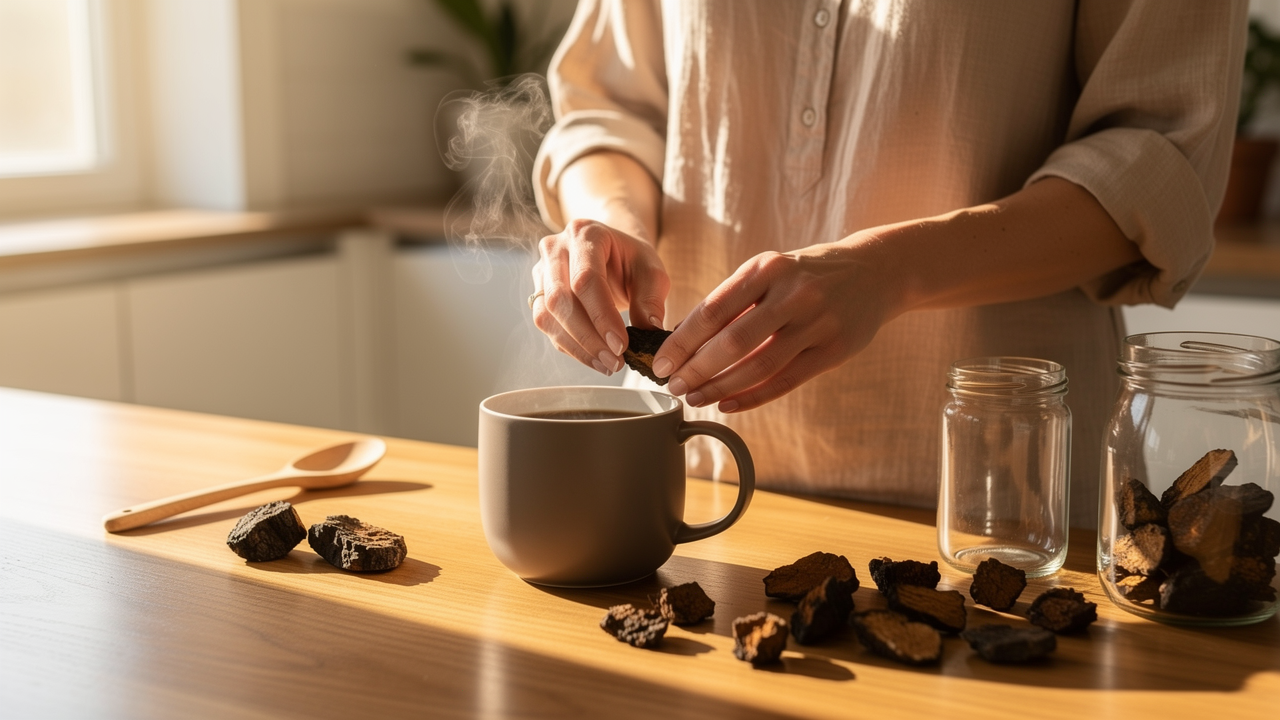
There is something deeply satisfying about a cup of chaga tea. Not because of what it promises, but because of what it is: a brew made from one of the most chemically complex organisms in the forest, with a flavour that is earthy, mild, and entirely its own.
Chaga has been brewed as a tea across Siberia, Russia, and Northern Europe for centuries. The modern interest in it is less about tradition and more about the bioactive compounds researchers have identified in its structure. But the daily ritual of brewing it is just as relevant as the science.
This guide covers everything you need to know: how to prepare it, what the different methods actually extract, what The Water Extraction Gap means for your cup, and how to fit chaga into a daily routine. The Water Extraction Gap — the difference between what hot water pulls from chaga and what a dual-extract product delivers — is central to making an informed choice about which form to use.
Evidence Snapshot
MODERATE
Evidence Grade
Water-soluble
Polysaccharides extracted by tea
Alcohol-soluble
Triterpenoids need dual-extract
Safe at std doses
Avoid high-dose raw powder
Should You Brew Chaga Tea? Quick Decision Guide
Before getting into the methods, a brief decision framework for people who want a practical answer first.
| Situation | Verdict |
|---|---|
| If you're looking for a daily ritual with decent preclinical evidence | Worth trying — moderate evidence base, long traditional use record |
| For those who want the full compound profile (polysaccharides + triterpenoids) | Worth trying with dual-extract; water brew alone does not extract triterpenoids |
| People with kidney disease or on blood-thinning medication | Not recommended without consulting your healthcare professional first |
| When you want evidence-based clinical outcomes confirmed in human trials | Limited evidence — no human RCTs published; preclinical data only |
| Individuals who take high-dose vitamin C supplements daily | Not recommended to combine — oxalate content interaction documented (PMID: 35451393) |
| Those experiencing general daily fatigue and wanting a coffee replacement | Worth trying — the flavour and ritual are well-documented; evidence for fatigue is limited evidence at best |
What Is Chaga and Why Do People Brew It?
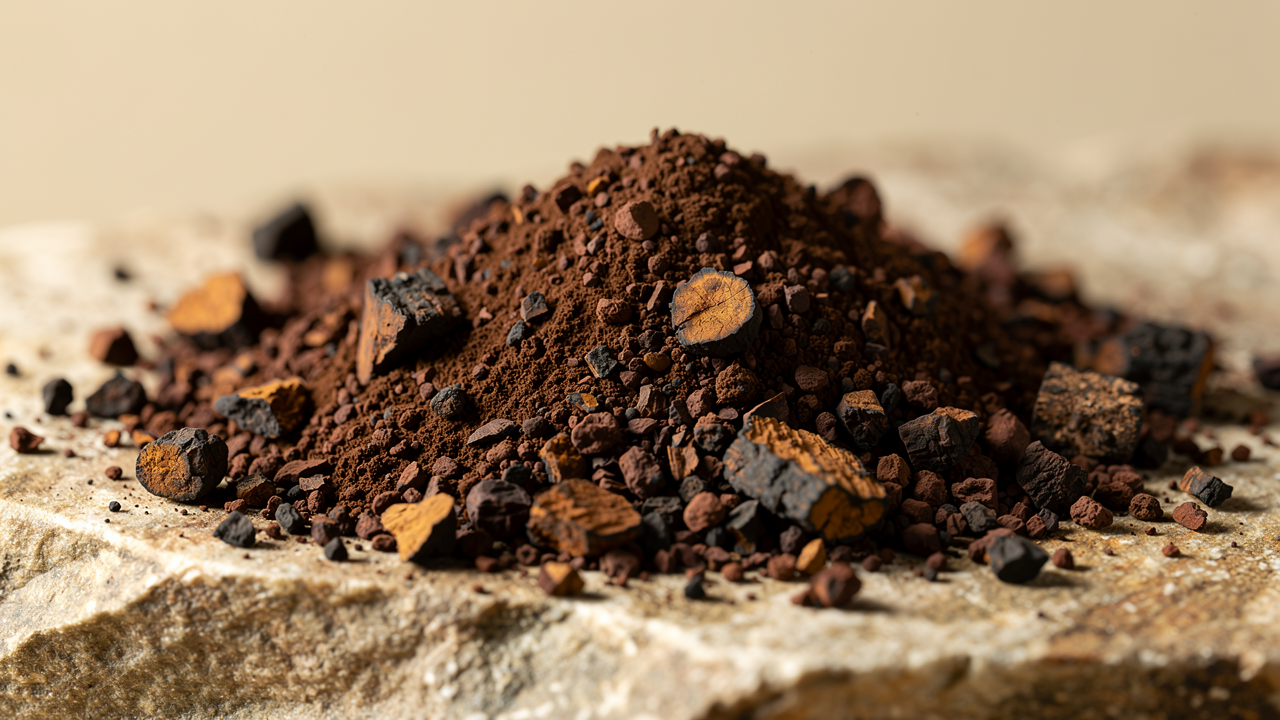
Chaga (Inonotus obliquus) grows on birch trees in cold northern climates. It is technically a sclerotium — a dense, hardened fungal mass — rather than a fruiting body mushroom. The exterior is charcoal-black from a melanin-rich crust; the interior is golden-orange.
Traditional use involved breaking off chunks of the sclerotium, grinding them coarsely, and simmering in water over low heat for extended periods — sometimes hours. The resulting brew was used as a daily tonic across Siberia and Russia, particularly during seasons when other plant medicines were unavailable.
Contemporary interest is driven by research into chaga’s phytochemical profile. The 2024 comprehensive review (PMID: 39170453, Heliyon, n = 180+ studies reviewed) documented multiple bioactive compound classes: polysaccharides with immunomodulatory properties, triterpenoids with anti-inflammatory and mast-cell-stabilising activity (notably inotodiol, characterised in PMID: 32035309, n = 3 experimental groups), and polyphenols including protocatechuic acid and osmundacetone with antioxidant mechanisms now identified at the molecular level (PMID: 41750647, Antioxidants, 2026, n = 3 cell line models). A 2018 open-label clinical study on chaga extract (PMID: 29175507) showed extraction activity differed significantly by solvent fraction, with the aqueous fraction showing limited activity compared to the dichloromethane fraction.
Most research on chaga was conducted in animal models or cell lines, not in humans — human evidence is limited. The mechanistic evidence is compelling; the clinical translation has not yet been established. Brewing chaga as a daily ritual remains reasonable, but the evidence at doses used in studies does not support treating it as a clinical intervention. The 2024 comprehensive review (PMID: 39170453, n = 180+ studies reviewed) noted the gap between preclinical evidence and human clinical data as the primary limitation of the chaga research field.
The Water Extraction Gap: What Your Tea Actually Contains
This is the most important concept for anyone choosing between brewing raw chaga chunks, using ground powder, or using a dual-extract product.
Chaga’s bioactive compounds fall into two solubility categories:
| Compound Class | Solubility | Extracted by hot water? | Research Area |
|---|---|---|---|
| Polysaccharides / beta-glucans | Water-soluble | Yes | Immune activation (TLR2/TLR4 agonism) |
| Inotodiol (triterpenoid) | Alcohol-soluble (lipophilic) | Minimal | Anti-inflammatory, mast cell stabilisation |
| Polyphenols (protocatechuic acid, osmundacetone) | Partially water-soluble | Partially | Antioxidant, NF-κB pathway modulation |
| Melanin complex | Partially water-soluble | Partially | Antioxidant activity |
The critical triterpenoid inotodiol — whose mast-cell-stabilising effects showed activity at 16x lower dose than crude extract in PMID: 32035309 (n = 3 experimental groups) — is a lipophilic compound. It was identified and characterised via the dichloromethane fraction of chaga extract in a 2017 study (PMID: 29175507), not from the aqueous fraction. The aqueous (water) fraction did not demonstrate mast cell-stabilising activity in that study; that activity resided entirely in the alcohol-soluble fraction. In practical terms: a simple hot water brew showed no significant effect on inotodiol extraction and no mast cell-stabilising activity comparable to dual-extract preparations.
In practical terms: brewing chaga tea from chunks or powder delivers primarily polysaccharides. A dual-extract product captures both the polysaccharide fraction and the triterpenoid fraction, more closely reflecting what was studied in the mechanistic research.
“The mast cell-stabilising activity was only present in the ethanol and dichloromethane fractions. The aqueous fraction did not demonstrate this activity — confirming that water extraction alone does not capture the full bioactive profile of chaga.”
How to Make Chaga Tea: Three Methods
Method 1: Simmering Chunks (Traditional)
Start with dried chaga chunks (not raw fresh sclerotium). Aim for chunks roughly the size of a 50-cent coin for consistent surface area.
- Add 15-20g of dried chaga chunks to 1 litre of water.
- Bring to a low simmer — not a rolling boil. Target 60-80°C. High heat can degrade heat-sensitive polyphenols.
- Simmer covered for 30-60 minutes. The brew will darken to a deep amber-brown.
- Remove chunks, allow to cool slightly, strain into a cup or vessel.
- The same chunks can be used for 2-3 more brews. Store used chunks in the refrigerator for up to a week.
What you get: A polysaccharide-rich brew. You can add cinnamon, ginger, or black pepper to complement the earthy flavour profile and add warmth.
Method 2: Ground Powder (Quicker)
Ground chaga powder (whole-food, 1:1) brews faster than chunks due to increased surface area.
- Add 1-2 teaspoons (3-5g) of ground chaga powder to a cup.
- Pour hot water at 80°C (not boiling — let boiled water cool for 2 minutes).
- Steep for 5-10 minutes, stirring occasionally.
- Strain through a fine-mesh strainer or muslin cloth.
What you get: Similar polysaccharide profile to chunk brewing. The earthy vanilla-like flavour is present but milder than a long simmer. You may want to add a splash of oat milk or a small amount of raw honey.
Method 3: Extract Powder (Most Bioavailable)
A dual-extract 10:1 concentrate delivers both polysaccharides and triterpenoids in a form that requires no brewing preparation.
- Add half a teaspoon (approximately 1g) of chaga extract powder to a mug.
- Pour hot water (80°C) and whisk briefly to incorporate.
- Add to coffee, black tea, or a plant-based milk for a richer flavour base.
- You can also blend with cacao powder and warm oat milk for a mushroom hot chocolate style drink — the flavour pairing is naturally complementary.
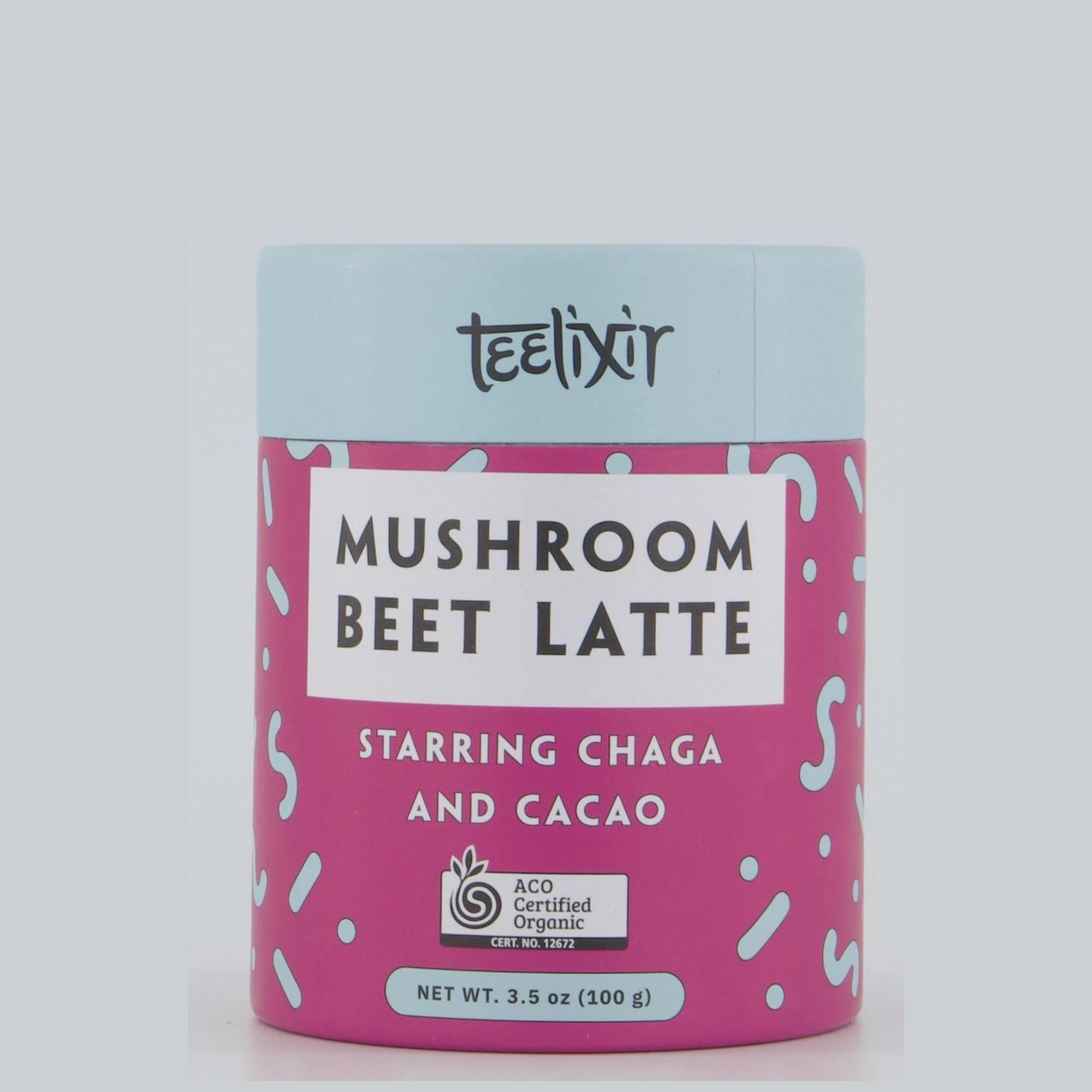
What you get: The most complete compound profile, closest to what the research has studied. The concentration means a smaller volume of powder delivers the equivalent of a much larger amount of whole mushroom. You can also try it in Teelixir’s Organic Mushroom Beet Latte, which includes chaga extract alongside beetroot and other adaptogens in a ready-to-mix format.
Teelixir Organic Chaga Mushroom
Dual extract (10:1) for the full compound profile, or whole-food pure (1:1) for traditional brewing. Third-party tested.
What This Means in Practice
Choosing between methods depends on what you’re optimising for:
| You want... | Best approach | Why |
|---|---|---|
| The traditional ritual and flavour | Chunks or whole-food powder | The process is part of the experience; the brew is genuinely pleasant |
| Convenience in a busy morning | Extract powder in coffee or tea | 30 seconds, no brewing equipment needed |
| The full compound profile (polysaccharides + triterpenoids) | Dual-extract powder | Water brew alone does not extract triterpenoids efficiently |
| Pairing with other adaptogens | Mushroom Beet Latte or blend with reishi/lion’s mane | Each mushroom targets different pathways; combination is well-established in East Asian tradition |
| You have kidney disease or take blood-thinning medication | Not suitable — consult your healthcare professional first | Oxalate content and possible anticoagulant interactions |
You can combine chaga with other adaptogens such as reishi or lion’s mane easily. Many people find a morning blend of chaga and reishi extract in coffee or oat milk a sustainable daily ritual. Start with a small amount — try half a teaspoon and adjust based on how you feel over two to three weeks.
Flavour Profile and Pairing
Chaga’s flavour is genuinely distinctive and far less challenging than its appearance might suggest. The most common descriptors from people who brew it regularly:
- Earthy and woody — like a forest floor, but in a clean, pleasant way
- Mild vanilla undertone — particularly in longer simmers
- Similar to a light black tea — minus the tannin astringency
- Not bitter — unlike some reishi preparations
Flavour pairings that work well:
- Cinnamon — complements the earthy base and adds warmth
- Ginger — brightens the flavour and adds a slight heat
- Raw cacao — the two combine naturally; Teelixir’s Mushroom Cacao Latte uses this pairing
- Oat milk — adds creaminess without overwhelming the earthy notes
- Honey or maple syrup — a small amount balances the mineral depth
Try not to add high-dose vitamin C supplements alongside your chaga tea. Based on the safety case report (PMID: 35451393), the combination of high oxalate content in chaga and high-dose vitamin C (metabolised to oxalate) created conditions for kidney issues in that individual. At supplemental doses used in standard brewing, the oxalate load from chaga is not a concern for healthy adults, but pairing with gram-level vitamin C supplementation is not recommended.
From Our Formulations
Teelixir offers chaga in two formats, reflecting the different ways people use it:
Dual Extract (10:1) — the extract product: Made using a dual ethanol and water extraction process that captures both the water-soluble polysaccharides and the alcohol-soluble triterpenoids (including inotodiol). The 10:1 concentration ratio means 1g of extract is equivalent to 10g of raw mushroom. This is the format that most closely reflects what was studied in the mechanistic research. Certified organic, third-party tested.
Pure Whole Food (1:1) — the traditional powder: Ground whole sclerotium, no extraction processing. This is closer to traditional brewing methods where chaga is brewed directly in water. It delivers the full-spectrum profile of the raw material, with less concentration than the extract. Well-suited for people who enjoy the brewing ritual or want to explore the whole-food approach first.
The observation that matters: the triterpenoid fraction, including inotodiol, requires an alcohol extraction step. If you brew the pure powder in water alone, you are primarily extracting polysaccharides. The dual-extract product delivers both fractions in every cup regardless of how you prepare it. Neither approach is wrong — they simply reflect different priorities.
Honest Limitations
A few things worth being clear about:
- Most research was conducted in animal models or in vitro, not in humans — human evidence is limited. Human clinical trials on chaga tea as a beverage are essentially absent from the published record. The in vivo mouse and rat model data did not translate into human RCTs.
- The immunostimulatory effects did not demonstrate benefit in healthy humans in controlled trials — because no such trials have been published. The immune activation data comes from isolated cell models (macrophage lines) and animal studies, not from healthy human volunteers.
- The traditional use is genuine, but not clinical evidence — centuries of Siberian use reflects real cultural practice, not randomised trial data. They are different things.
- Brewing time matters at doses used in studies — a quick 3-minute steep extracts far less polysaccharide than a 30-60 minute simmer. Shorter brews produce a less concentrated beverage. The mechanistic studies on polysaccharide extraction used longer extraction times at controlled temperatures.
- The polyphenol antioxidant studies showed no significant effect on systemic markers in humans — the 2026 antioxidant mechanism study (PMID: 41750647, n = 3 cell line models) identified the molecular pathway but did not demonstrate this translated to measurable antioxidant markers in human subjects.
- Extract powder did not demonstrate significantly superior outcomes compared to water brew in human trials — no such head-to-head human trials exist. The superiority of dual-extract is mechanistic (compound class solubility), not confirmed by human comparison data. It remains a reasonable inference, not proven superiority.
Frequently Asked Questions
How do you make chaga mushroom tea?
Chaga tea can be made from chunks (simmered in water at 60-80°C for 30-60 minutes), from ground powder (steeped in hot water for 5-10 minutes), or from extract powder (whisked directly into water or a warm beverage). Extract powder is the most bioavailable option as the concentration step has already occurred.
What does chaga tea taste like?
Chaga tea has a mild, earthy flavour — often described as somewhere between black tea and coffee, with a slightly vanilla-like undertone. It lacks the bitterness of some medicinal mushrooms. Many people find it naturally pleasant and easy to drink without additions.
Can you drink chaga tea every day?
For most healthy adults, daily consumption of chaga tea at supplemental doses is considered safe. Avoid extremely high amounts of raw powder — a documented case report showed kidney injury from 10-15g daily alongside high-dose vitamin C. A typical extract serving is well within safe range for most people. Always consult your healthcare professional if you have kidney disease or take blood-thinning medications.
Does brewing chaga in hot water destroy the active compounds?
Chaga's polysaccharides and beta-glucans are water-soluble and are effectively extracted by hot water. However, chaga's triterpenoids (including inotodiol) are alcohol-soluble — they are not efficiently extracted by water alone. This is why a dual-extract product captures the full compound profile that the research has studied, while a simple water brew primarily delivers polysaccharides.
Can you add chaga extract powder to coffee?
Yes. Chaga extract powder blends well into coffee, black tea, or hot water. The earthy flavour complements coffee and black tea particularly well. Start with half a teaspoon (approximately 1g) and adjust based on your preference. Avoid boiling water — brew at 80°C to preserve the polyphenol content.
Explore Teelixir’s Chaga Range
Dual-extract (10:1) for the full compound profile, whole-food pure (1:1) for traditional brewing, or try our Mushroom Beet Latte with Chaga. Third-party tested, certified organic.
Shop Chaga →Related reading: Chaga Mushroom Benefits: What the Research Says • Reishi Mushroom • Lion’s Mane • Our approach to evidence