



Cordyceps Mushroom Benefits: What 28 Human Studies Actually Show
By Peter Orpen, Co-Owner, Teelixir
28 human studies reviewed. Three mechanisms that are the subject of ongoing research. Cordyceps has been traditionally used and is the subject of modern scientific investigation. Here is an honest look at what cordyceps may support — and what the evidence shows.

What 28 Human Studies Actually Show About Cordyceps
Most cordyceps marketing promises you'll feel like a Tibetan monk who can run at altitude indefinitely. Most of it is borrowed from animal studies, exaggerated, or quietly omitted when it doesn't hold up.
This article covers what cordyceps actually does — and doesn't do — based on 28 human studies including 6 meta-analyses, 7 RCTs, and 3 clinical trials. We'll give you the honest picture, including the null findings that most brands won't mention.
The Oxygen Amplifier Effect is an area of ongoing research: cordyceps has been traditionally used to support energy and is being investigated for its potential effects on oxygen utilization. Some studies suggest it may be particularly relevant in certain conditions like high-altitude environments, though more research is needed.
Evidence Snapshot
28
Human Studies
6
Meta-analyses
7+
RCTs
MODERATE
Evidence Grade
The Biology: Why Cordyceps Might Actually Work
Cordyceps contains several bioactive compounds — primarily cordycepin (3'-deoxyadenosine), adenosine, beta-glucan polysaccharides, and mannitol. The most studied mechanism relates to adenosine signalling and its downstream effects on mitochondrial efficiency and oxygen utilisation.
In simple terms: cordycepin resembles adenosine closely enough that it is the subject of ongoing research into its potential interactions with adenosine receptors, which are involved in various physiological processes.
Most studies on the detailed molecular mechanism were animal or in vitro. The human evidence focuses on general outcomes rather than confirming specific pathways. That's worth knowing before you dig into the findings.
Athletic Performance: The Credible Evidence
The most compelling human data on cordyceps and performance comes from a 2025 meta-analysis of 14 RCTs involving 528 athletes (PMID: 41280379). It found cordyceps sinensis supplementation significantly improved endurance performance (p=0.05), ventilatory threshold (p=0.03), and VO2peak (p=0.04), with low heterogeneity across studies — a stronger signal than most supplement meta-analyses produce.
At the individual study level, a 12-week double-blind RCT in healthy older adults found that Cs-4 at 333mg/day increased the metabolic threshold by 10.5% and the ventilatory threshold by 8.5% versus placebo (PMID: 20804368). The metabolic threshold — the point at which lactate begins to accumulate — is a genuine marker of aerobic capacity. An 10.5% shift is clinically meaningful.
A 2024 RCT in long-distance runners found Cordyceps militaris mycelium extract significantly maintained ferritin, haemoglobin, and haematocrit over 16 weeks versus placebo (PMID: 38931190), with creatine kinase also significantly lower at 16 weeks — suggesting a muscle-protective effect during heavy training.
Perhaps the most novel finding: a 2024 randomised crossover trial found that a single 1g dose of cordyceps taken before high-intensity exercise accelerated CD34+ stem cell recruitment to damaged muscle by 51% at 3 hours post-exercise, resulting in a four-fold expansion of satellite cells (PMID: 38501161). This is the first human biopsy evidence that cordyceps accelerates resolution of exercise-induced muscle damage.

The Null Findings You Need to Know
Before you treat the positive data as settled, here are the null results that matter — and what they tell you about when cordyceps is and isn't likely to help.
A 5-week RCT in 22 older trained cyclists found Cs-4 at 3g/day found no significant effect on VO2peak in those older cyclists, despite being a population where you'd expect the most room for improvement (PMID: 15118196). Duration matters: 5 weeks may simply be insufficient to drive meaningful adaptation.
A 14-day RCT in 17 amateur cyclists at 5g/day did not demonstrate improvement in VO2max in amateur cyclists (PMID: 15076794). This reinforces the duration question — two weeks is unlikely to be enough regardless of dose.
A crossover RCT in 8 elite cyclists using a Rhodiola-Cordyceps combination for 2 weeks showed no significant haemodynamic improvement in elite cyclists (PMID: 15903375). Elite athletes operating at peak capacity are unlikely to show gains from supplementation — there's simply less headroom.
And a 2020 RCT in 21 active men using a multi-ingredient pre-workout containing cordyceps found no significant effect on body composition or performance over 6 weeks (PMID: 33078636). Cordyceps in a stack context, over a short period, is not reliably effective.
The pattern in the null data is instructive: short duration + trained athletes + multi-ingredient formulas = weak or absent signal. The positive data clusters around longer supplementation (12+ weeks), less-trained adults, and single-ingredient protocols.
"Cordyceps sinensis supplementation significantly improved endurance performance, ventilatory threshold, and VO2peak across 14 RCTs — with low heterogeneity." — PMID 41280379, 2025 meta-analysis, n=528 athletes
Immune Support: Robust Human Evidence
This is where cordyceps has arguably its strongest human data set.
A landmark 12-week RCT in 79 healthy adults receiving Cordyceps militaris fermented mycelium at 1.5g/day found significant increases in NK cell activity at 4 and 8 weeks, IL-2 at 4 weeks, and IFN-gamma at 8 weeks versus placebo (PMID: 26284906). NK cells are the front-line killers of virus-infected and abnormal cells — this is a direct and clinically relevant immune measure.
A 2024 8-week RCT with healthy adults consuming a Cordyceps militaris fermented beverage confirmed these findings: NK cell activity significantly increased in men at 4 weeks (p=0.049) and in women at 8 weeks (p=0.023), while the pro-inflammatory marker IL-1β reduced in men and IL-6 decreased in women (PMID: 38580687).
A 2026 systematic review concluded that C. militaris consistently demonstrates immunomodulatory effects including NK cell activation, IL-2 and IFN-gamma upregulation, and Th1/Th2 modulation, with safety confirmed at doses of 1-3g/day across multiple human trials (PMID: 41432716).
What This Means in Practice
Based on the human evidence, here is where cordyceps is likely to deliver value — and where you should temper your expectations.
| Situation | Evidence Verdict | Confidence |
|---|---|---|
| Healthy adult seeking immune support, 12+ weeks | Likely effective — NK cell data is consistent across multiple RCTs | Moderate-High |
| Active adult seeking endurance improvement, 12+ weeks | Probably effective — ventilatory threshold data is promising | Moderate |
| Elite athlete looking for quick performance edge | Unlikely to help — null data in elite athlete cohorts | Low |
| Person using cordyceps in a multi-ingredient stack | Results unclear — confounders make individual contribution hard to isolate | Low-Moderate |
| Post-exercise recovery support | Promising — novel stem cell recruitment data (single study, needs replication) | Preliminary |
You can take cordyceps year-round if your goal is immune maintenance. Start with 1-1.5g/day and consider increasing to 2-3g/day if your primary goal is performance — the higher doses appear in the endurance studies. Allow at least 8-12 weeks before evaluating results.
Pair with your morning routine. Cordyceps does not cause sedation, so you can take it alongside other adaptogens without timing conflicts. Consider combining with lion's mane if cognitive stamina alongside physical endurance is your goal. You may want to take a 1-month break every 3-4 months as a precaution, though the safety data shows no harm from continuous use.
Safety: What the Trials Show
A 3-month RCT in 49 healthy adults found Cordyceps cicadae safe and well-tolerated with no serious adverse events and no clinically significant changes in haematological, renal, or hepatic markers (PMID: 32702252). Blood pressure, glucose, lipids, and renal function all remained normal throughout supplementation at doses used in studies.
The 2026 systematic review confirmed no serious adverse events at 1-3g/day across multiple human trials (PMID: 41432716). This is unusually clean safety data for a supplement category.
Cordyceps is not recommended during pregnancy or breastfeeding due to insufficient safety data. If you're taking immunosuppressive medications, consult your healthcare professional before use — cordyceps' immunomodulatory activity could theoretically interact with these drugs. It is not suitable for people with autoimmune conditions without medical supervision.
From Our Formulation
Teelixir sources Cordyceps CS-4 from Xi'an Lifewe Biotech (Yes Herbs) in China — a strain of Cordyceps sinensis grown via liquid mycelium culture, not harvested wild. The CS-4 strain is the most clinically studied cultivated cordyceps strain in the human performance literature and produces consistent, verifiable beta-glucan content.
Our COA (batch C24050306, May 2024) shows 31.3% beta-glucan — significantly above the minimum specification of ≥20%. The extraction method is hot water only; no ethanol is used. This matters because water extraction preserves the polysaccharide fractions (including the beta-glucans responsible for the immune data), while avoiding the extraction of compounds that are poorly characterised for safety.
The extract is tested at 80 mesh with 1.74% moisture loss on drying — well within specification. Heavy metals are below all limits: lead ≤3.0mg/kg, arsenic ≤2.0mg/kg, cadmium ≤1.0mg/kg, mercury ≤0.1mg/kg. E. coli and Salmonella: negative.
One observation worth noting: the academic literature on cordyceps performance is split between studies using Cordyceps militaris (fruiting body) and Ophiocordyceps sinensis (wild or cultivated). The CS-4 mycelial strain is distinct from both. Most of the positive endurance data uses CS-4 specifically — which means our formulation is in the right research lane.
Teelixir Organic Cordyceps — 31.3% Beta-Glucan
CS-4 strain, hot water extract, heavy metal tested. From $42.
Cordyceps Versus the Alternatives
If you're deciding between cordyceps and other adaptogens, here's the honest comparison.
For pure immune support, cordyceps and lion's mane take different approaches — cordyceps may help support innate immunity, while lion's mane supports nerve growth factor and has some emerging immune data. If immune resilience is your goal, cordyceps has human evidence worth considering for that specific outcome.
For stress and HPA axis modulation, ashwagandha has stronger human evidence (STRONG grade, 100+ studies). If adrenal fatigue and cortisol management are your primary concerns, ashwagandha is the better starting point. Cordyceps and ashwagandha stack well together — the mechanisms don't overlap.
For general metabolic vitality and endurance, cordyceps has been traditionally used in this capacity and is the subject of ongoing research in the mushroom category.
Frequently Asked Questions
How long does cordyceps take to work?
The human trial data suggests meaningful effects on endurance markers appear at 8-12 weeks of consistent supplementation. Immune effects (NK cell activation) have been observed as early as 4 weeks in RCT conditions. Expecting results in 1-2 weeks is not supported by the evidence — short-term cordyceps supplementation consistently fails to show benefits even in well-designed trials.
What dose of cordyceps do the studies use?
Human studies have used doses ranging from 333mg to 6g/day depending on the application. The immune support studies (PMID 26284906, PMID 38580687) used 1.5-2.85mg cordycepin equivalent doses. The endurance studies generally used 333mg-3g/day of Cs-4 extract. At doses used in studies of 1-3g/day, no safety concerns were identified over 3 months. Starting at 1g/day and titrating to 2-3g/day over 4 weeks is a reasonable approach.
Is cordyceps safe to take every day?
Based on available human trial data, yes. A 3-month RCT in 49 healthy adults (PMID: 32702252) found no serious adverse events and no changes in liver, kidney, blood pressure, or metabolic markers. The 2026 systematic review confirmed safety at 1-3g/day across multiple trials (PMID: 41432716). As with any supplement, if you're pregnant, breastfeeding, or taking immunosuppressive medications, consult your healthcare professional before use.
What is the difference between Cordyceps militaris and Ophiocordyceps sinensis?
Ophiocordyceps sinensis (the wild Tibetan caterpillar fungus) is the most historically used species but is extremely rare and expensive — most products sold as "Cordyceps sinensis" are actually cultivated mycelium or use the CS-4 mycelial strain. Cordyceps militaris is the cultivated fruiting body species, more widely available, and the subject of most recent human RCT immune data. Both have human evidence; the CS-4 mycelial strain specifically has the largest performance research base.
Can I take cordyceps with other mushroom supplements?
Yes. Cordyceps stacks well with lion's mane (complementary mechanisms — energy vs cognition), reishi (adaptogen synergy), and ashwagandha. There is no evidence of adverse interactions between these supplements. However, no head-to-head combination trial exists comparing individual vs stacked cordyceps intake in healthy adults, so individual contribution in a stack cannot be confirmed by the current evidence. Start with cordyceps alone for 4-6 weeks before adding others so you can assess its effects.
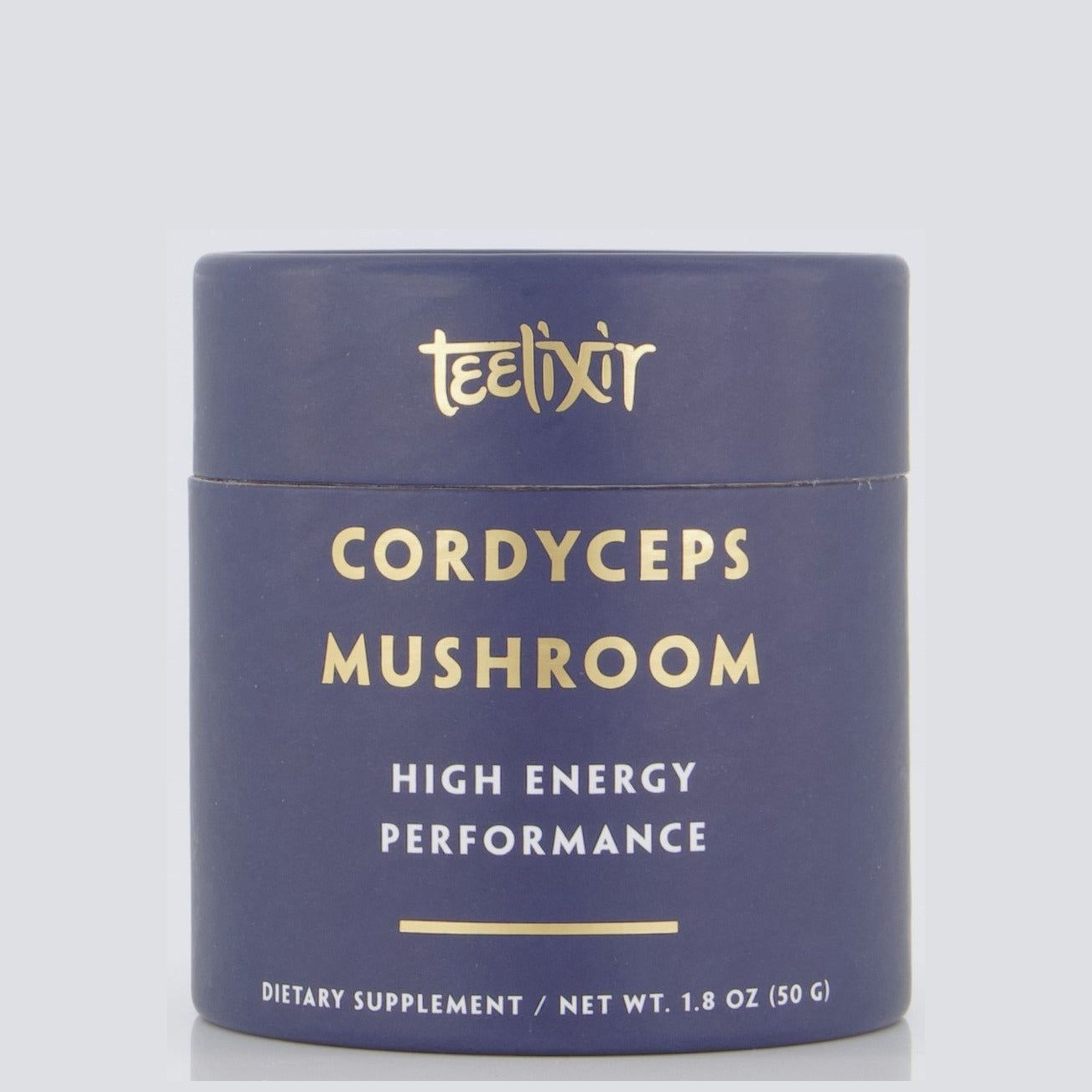
Teelixir Organic Cordyceps — CS-4 Strain, 31.3% Beta-Glucan
Hot water extracted, heavy metal tested, GMO free. The most clinically studied cordyceps strain. From $42.
Shop Cordyceps →This article is for educational purposes only and does not constitute medical advice. Cordyceps supplements are not intended to diagnose, treat, cure, or prevent any disease or health condition. Always consult your healthcare professional before commencing any new supplement regimen, particularly if you are pregnant, breastfeeding, have an existing medical condition, or are taking prescription medication. Individual results may vary.


