



Lion's Mane Powder vs Extract vs Capsules: Which Form Is Best?
By Peter Orpen, Co-Owner, Teelixir
By Teelixir Research Team · Published 24 March 2026 · Updated 24 March 2026
Evidence Snapshot: Lion's Mane Formats
STRONG
Evidence Grade
567
Published Studies
7
Human RCTs
31.7%
Beta-Glucan (COA)
You have probably seen lion's mane mushroom sold as a raw powder, a concentrated extract, and in capsule form. You have probably also noticed the price difference between them. And you have probably wondered: does the form actually matter, or is it just marketing?
It matters enormously. The form you choose determines how much of lion's mane's bioactive compounds — hericenones and erinacines — actually reach your bloodstream. In a 2023 double-blind RCT (PMID: 38004235, n=41), participants supplemented with a concentrated lion's mane extract showed significant improvements in cognitive performance within just 28 days. But the extract used was not a simple dried powder. It was a standardised, concentrated form with verified bioactive content.
This guide breaks down the three most common formats — powder, extract, and capsules — with the evidence behind each, so you can make a genuinely informed decision. If you are still learning about this mushroom, our guide on how to use lion's mane covers the basics, while our timing guide explains when to take it for best results.
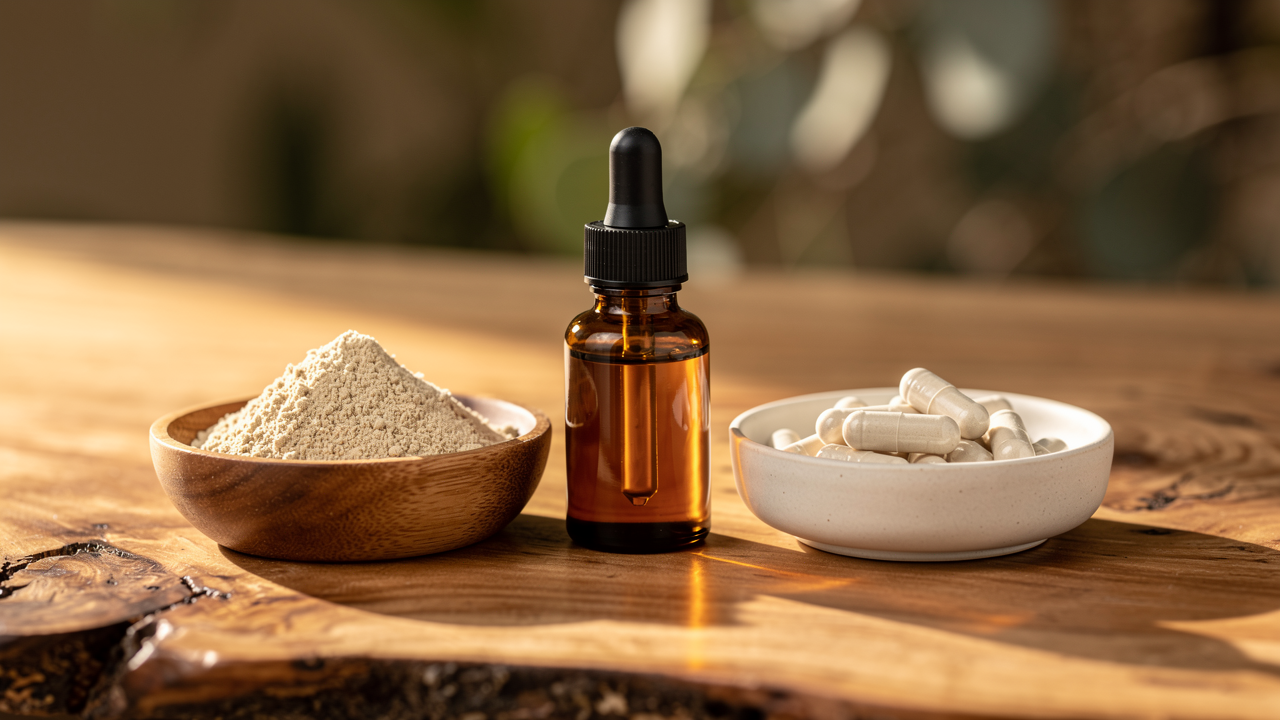
Raw Powder: The Whole Mushroom, Ground Up
Raw lion's mane powder is exactly what it sounds like: the dried fruiting body, milled into a fine powder. No extraction process. No concentration. What you get is the whole mushroom, fibre and all.
The advantage is simplicity. You are consuming the complete matrix of the mushroom — beta-glucans, polysaccharides, dietary fibre, minerals, and trace compounds. Some practitioners value this "whole food" approach because it preserves the natural ratio of constituents.
The disadvantage is potency. Many of lion's mane's most researched bioactives — particularly the hericenones (found in the fruiting body) and erinacines (found primarily in mycelium) — are locked inside tough chitin cell walls. Without an extraction process to break these walls, your digestive system may absorb only a fraction of the available compounds.
A 2023 review of Hericium erinaceus bioactives (PMID: 37233262) noted that erinacines require specific extraction conditions to become bioavailable. Simply grinding and ingesting the raw mushroom does not guarantee adequate absorption of these compounds.
Best for: People who prefer whole-food supplements, enjoy adding mushroom powder to smoothies or cooking, and are not targeting specific cognitive or neurological outcomes.
Concentrated Extract: Where the Evidence Points
A concentrated extract uses solvents — typically hot water, ethanol (alcohol), or both — to break down the chitin cell walls and pull out specific bioactive compounds. The resulting material is then concentrated, often to a ratio like 10:1, meaning 10 kilograms of raw mushroom produces 1 kilogram of extract.
This is the form used in many clinical trials investigating cognitive effects.
In the landmark 2023 RCT by La Monica et al. (PMID: 38004235, n=41), healthy young adults took 1.8g of lion's mane extract daily. The extract group showed significantly faster performance on cognitive tasks compared to placebo after 28 days. Crucially, the researchers used a concentrated, standardised extract — not a raw powder.
A 2025 double-blind RCT (PMID: 40276537) confirmed acute cognitive benefits from a standardised Hericium erinaceus extract in healthy younger adults, with improvements in reaction time and attention measured within hours of a single dose.
The dual extraction method is particularly important for lion's mane. Hot water extraction pulls out the water-soluble beta-glucans and polysaccharides. Ethanol extraction captures the alcohol-soluble hericenones and terpenoids. A single-solvent extraction misses an entire category of bioactives.
Our dual-extract lion's mane uses both hot water and ethanol extraction at a 10:1 concentration ratio. Independent laboratory testing confirms 31.7% beta-glucan content — verified on our Certificate of Analysis, not estimated from generic species data. The fruiting body is Di Tao sourced from its traditional growing region in China and is certified organic by Australian Certified Organic (ACO).
Best for: Anyone seeking to explore the potential cognitive, neurological, or mood effects supported by preliminary research. The extract format delivers the highest concentration of bioactive compounds per gram.
Head-to-Head Comparison
| Factor | Raw Powder | Concentrated Extract | Capsules |
|---|---|---|---|
| Bioavailability | Low — chitin blocks absorption | High — extraction breaks cell walls | Depends on what is inside the capsule |
| Beta-Glucan Content | 5–15% typical | 30%+ (Teelixir: 31.7% verified) | Varies widely by brand |
| Concentration Ratio | 1:1 (no concentration) | 10:1 | Usually 1:1 to 4:1 |
| Preliminary research | Minimal — most trials use extracts | Strong — used in 7 RCTs | Depends on capsule contents |
| Convenience | Requires mixing (coffee, smoothie) | Requires mixing (dissolves easily) | Most convenient — swallow and go |
| Taste | Mild, slightly earthy | Mild, slightly earthy | No taste |
| Cost Per Effective Dose | Low upfront, but need larger doses | Best value — small dose, high potency | Higher — capsule markup + lower potency |
Capsules: Convenience With a Caveat
Capsules are the most convenient format. No measuring, no mixing, no taste. You swallow them and move on with your day.
But convenience comes at a cost — and not just the price markup. The critical question with any lion's mane capsule is: what is actually inside?
Some capsule products contain raw powder (ground mushroom with no extraction). Others contain a concentrated extract. A few contain mycelium grown on grain, which may be mostly rice starch with minimal active compounds. Without third-party testing data and a Certificate of Analysis, it is impossible to know what you are actually taking.
A 2025 study (PMID: 36582308) that investigated four weeks of Hericium erinaceus supplementation found no significant impact on markers of metabolic flexibility or cognition. The researchers noted that the product used may not have contained sufficient bioactive concentrations — highlighting how much the specific product formulation matters.
If you prefer capsules, look for products that contain a concentrated extract (not just raw powder), disclose their extraction method and concentration ratio, and provide third-party beta-glucan testing results.
Best for: People who value convenience above all else and are willing to pay more per effective dose. Always verify the capsule contains an extract, not raw powder.
Which Form Should You Choose?
Why Extraction Method Matters More Than Format
Here is the uncomfortable truth that most supplement companies will not tell you: the format (powder, capsule, liquid) matters far less than the extraction method and concentration ratio.
A capsule containing 10:1 dual-extracted lion's mane will outperform a raw powder every time, regardless of dose. Conversely, a capsule filled with unextracted ground mushroom offers no meaningful advantage over simply eating the mushroom.
The 2024 ALSUntangled review (PMID: 38141002) examined the mechanisms of action in Hericium erinaceus for neurodegenerative disease and emphasised that the preparation method — particularly whether extraction preserved the erinacines and hericenones — was critical to any potential therapeutic effect.
When evaluating any lion's mane product, ask three questions:
- Is it extracted? Hot water extraction (minimum) or dual extraction (ideal) is necessary to break chitin cell walls.
- What is the concentration ratio? A 10:1 ratio means 10kg of raw material concentrated to 1kg — significantly more potent than 1:1.
- Is the beta-glucan content verified? Look for a Certificate of Analysis with a specific percentage — not generic claims.
Honest Limitations
No Cochrane systematic review currently exists comparing lion's mane supplement formats head-to-head. Most clinical trials use concentrated extracts, which means we have strong evidence for extracts but limited direct evidence for raw powder effectiveness at equivalent doses. The 2025 null-result study (PMID: 36582308) reminds us that not all lion's mane products are created equal — formulation quality is a genuine variable in outcomes.
Additionally, FSANZ has no specific permitted health claims for lion's mane in Australia, and EFSA beta-glucan claims apply only to oat and barley sources, not mushroom-derived beta-glucans. The evidence is promising but the regulatory landscape has not yet caught up. For a deeper look at the research, visit our science page.
Teelixir Lion's Mane Extract
Dual extract (hot water + ethanol) · 10:1 concentration · 31.7% beta-glucan · 100% fruiting body · Di Tao sourced · ACO certified organic
View ProductFrequently Asked Questions
Is lion's mane powder the same as lion's mane extract?
No. Raw powder is simply dried, ground mushroom with no extraction. An extract uses hot water, ethanol, or both to break down chitin cell walls and concentrate bioactive compounds like hericenones and erinacines. Extracts typically contain 2–10 times higher concentrations of active compounds per gram.
What does 10:1 concentration ratio mean?
A 10:1 ratio means 10 kilograms of raw lion's mane mushroom were used to produce 1 kilogram of extract. This concentrates the bioactive compounds, making each gram of extract roughly equivalent to 10 grams of raw mushroom.
Why is dual extraction important for lion's mane?
Lion's mane contains both water-soluble compounds (beta-glucans, polysaccharides) and alcohol-soluble compounds (hericenones, terpenoids). A single-solvent extraction misses an entire category of bioactives. Dual extraction with both hot water and ethanol captures the full spectrum of researched compounds.
Can I just eat fresh lion's mane mushroom instead?
Fresh lion's mane is a delicious culinary mushroom with some nutritional benefits. However, cooking does not extract bioactives as effectively as a controlled dual-extraction process. You would need to consume very large quantities of fresh mushroom to approach the bioactive concentration found in a quality extract. For general nutrition, fresh mushroom is fine. For targeted cognitive or neurological support, an extract is more practical.
Are lion's mane capsules worth the extra cost?
It depends on what is inside them. Capsules containing a concentrated dual extract offer the same benefits as extract powder, just in a more convenient format with a slight price premium. Capsules containing raw, unextracted powder offer significantly less bioavailability per gram. Always check the label for extraction method, concentration ratio, and third-party testing data.
Disclaimer: This article is for informational and educational purposes only and does not constitute medical advice. Always consult a qualified healthcare professional before starting any new supplement, especially if you are pregnant, breastfeeding, or taking medications.
Continue Your Research
- Lion's Mane Benefits: What 571 Studies Actually Show
- Lion's Mane Tea: How to Brew It Right
- How to Cook with Lion's Mane: 9 Recipes (Fresh + Extract Powder)
- Lion's Mane: Fruiting Body vs Mycelium
- Lion's Mane Dosage Guide: Clinical Trial Doses, Extract Conversions & Timing
- Lion's Mane Side Effects: Safety Profile Review
- Lion's Mane for ADHD and Focus: What the Research Actually Shows
- Lion's Mane for Anxiety: What the Research Actually Shows


