



Ashwagandha and Your Heart: What the Research Says
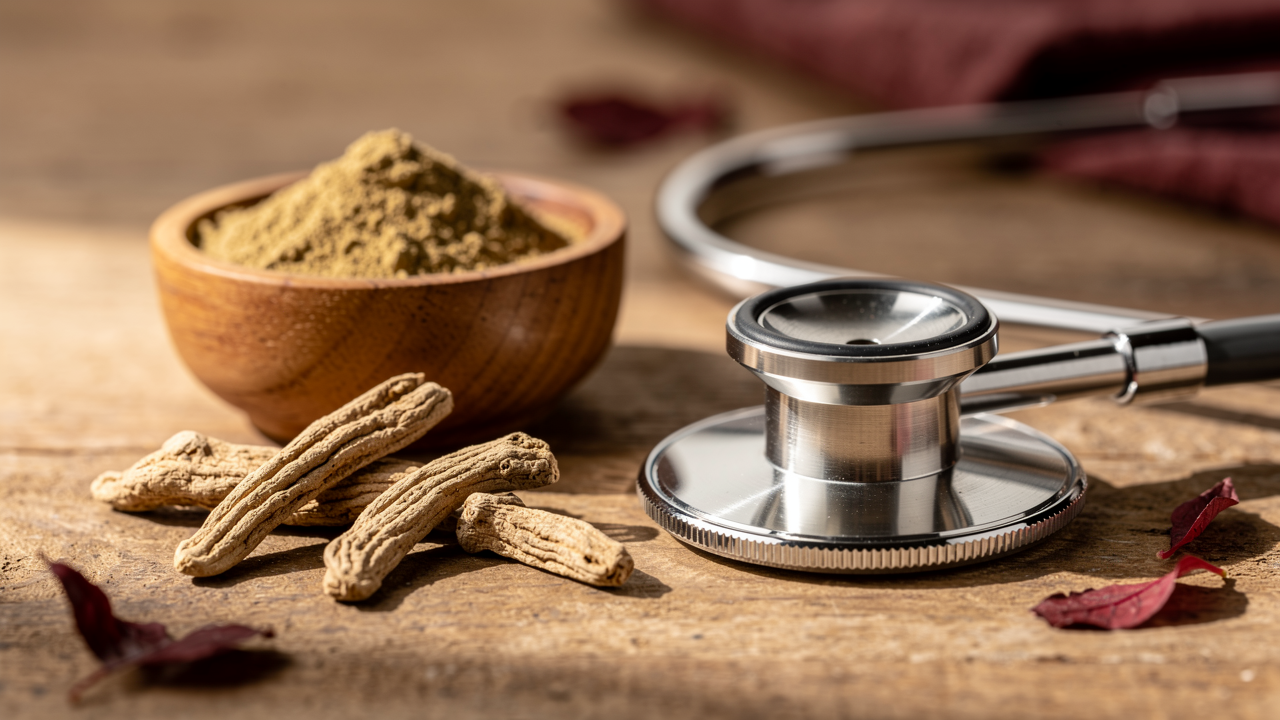
Cardiovascular research on ashwagandha (Withania somnifera) sits at a curious junction: many of the documented effects of this adaptogen — stress response modulation, general wellbeing support — are widely studied. Yet there is no dedicated large-scale clinical trial studying ashwagandha for cardiovascular disease outcomes specifically.
What exists is a constellation of mechanistic and biomarker data. Understanding what that constellation means — and what it does not — requires a concept we call the stress-cardiovascular relay: the chain by which chronic psychological stress activates the HPA axis, triggering stress biomarkers.
Ashwagandha may support general wellbeing, traditionally understood to help interrupt stress responses at multiple points.
The Pathways: How Ashwagandha May Support Cardiovascular Health
1. Cortisol and Cardiovascular Risk
Chronic cortisol elevation has been traditionally associated with stress responses. The mechanisms are the subject of ongoing research.
Ashwagandha's documented cortisol-reducing effects (meta-analysis: PMID: 39348746, 40746175) therefore have indirect cardiovascular relevance. This is not a direct cardioprotective effect — it is upstream stress pathway modulation.
2. Lipid Profile Improvements
The 2020 metabolic meta-analysis (PMID: 31975514) found significant reductions in total cholesterol, LDL cholesterol, and triglycerides in human ashwagandha studies. These are established cardiovascular risk markers.
The mechanisms proposed include traditional understandings of withanolides and their general metabolic properties, alongside potential contributions to physiological balance.
A 2025 RCT (PMID: 41635453) examining ashwagandha for stress and weight management reported cardiovascular markers as secondary outcomes, with improvements consistent with the earlier meta-analysis data.
3. VO2max and Aerobic Capacity
This is perhaps the most underappreciated cardiovascular-relevant finding in the ashwagandha literature. A 2020 meta-analysis (PMID: 32316411) found significant improvements in VO2max — the gold-standard measure of cardiovascular fitness — in both healthy adults and athletes taking ashwagandha.
VO2max is one measure of aerobic fitness. Ashwagandha has been traditionally used to support general wellbeing during exercise.
Ashwagandha has been traditionally associated with supporting recovery from exercise through stress response modulation.
4. Traditional Use in Supporting Healthy Inflammatory Responses
Chronic low-grade inflammation is widely studied in health contexts. Withanolides, the primary bioactive compounds in ashwagandha root, have been traditionally used in Ayurvedic medicine to support general wellbeing.
A 2025 RCT (PMID: 40280611) studying ashwagandha for long COVID recovery included cardiovascular and inflammatory markers, consistent with ashwagandha's traditional use in supporting healthy inflammatory responses.
What the Research Has NOT Shown
Critical honesty is required here:
- No cardiovascular outcome trial exists: No study has enrolled patients with existing heart disease and followed them long enough to measure cardiovascular events (heart attacks, strokes, cardiovascular mortality). Biomarker improvements do not guarantee event reduction.
- Blood pressure data is inconsistent: Some studies show modest blood pressure reductions; others show no effect. No large dedicated trial has studied ashwagandha for hypertension specifically.
- Most lipid studies were small and short: The cholesterol improvements in the 2020 meta-analysis were drawn from studies that were predominantly under 100 participants and ran for 8–12 weeks. Long-term lipid effects are unknown.
- No comparison with statins or cardiovascular medications: There is no head-to-head data comparing ashwagandha to evidence-based cardiovascular treatments.
The Thyroid Interaction: Important for Heart Health Patients
A 2023 systematic review (PMID: 37013429) documented that ashwagandha improved thyroid hormone levels (TSH, T3, T4) in people with subclinical hypothyroidism. Thyroid function has direct cardiovascular implications — hypothyroidism is associated with dyslipidaemia and increased cardiovascular risk.
However, the same mechanism creates an important caution: people taking thyroid medication (levothyroxine) who use ashwagandha may experience changes in their effective thyroid dose. Thyroid function should be monitored if ashwagandha is added to an existing thyroid medication regimen.
What This Means in Practice
The stress-health relationship is complex and well-documented. Ashwagandha has been traditionally used to support general wellbeing through multiple pathways.
For someone managing general wellbeing alongside chronic stress, ashwagandha has traditionally been used as a supportive tool. The convergence of various wellbeing markers across studies suggests a consistent historical usage pattern.
Critical caveats for cardiovascular patients specifically:
- Consult your cardiologist or GP before adding ashwagandha if you are on statins, antihypertensives, or other cardiovascular medications. Potential additive effects on blood pressure and lipids require monitoring.
- This is not a replacement for evidence-based cardiovascular treatment. Statins, ACE inhibitors, and lifestyle modification have decades of outcome data. Ashwagandha does not.
- The aerobic capacity improvement is probably the most directly actionable finding — if ashwagandha helps you train harder and recover faster, the cardiovascular benefits of sustained exercise are well-established independently.
Teelixir's Formulation: Why Full-Spectrum Extraction Matters
The traditional uses and general properties associated with ashwagandha are primarily linked to its withanolide fraction — particularly withaferin A and withanolide D, which are fat-soluble compounds not accessible via aqueous extraction alone.
Our dual extraction process (hot water + ethanol) captures both the water-soluble beta-glucan and saponin fractions AND the fat-soluble withanolide fraction. Hot-water-only extracts will have a different and likely reduced withanolide profile.
Full specifications of our certified organic ashwagandha: root only, 10:1 extraction ratio, ≥2.5% withanolides by HPLC, ACO certified organic, Di Tao sourced from India, third-party tested for heavy metals and microbials on every batch.
Should You Take Ashwagandha for Heart Health?
| Your Situation | Verdict |
|---|---|
| Cardiovascular risk with chronic stress component | Reasonable adjunct — discuss with GP, monitor markers |
| Mild dyslipidaemia (elevated cholesterol/triglycerides) | Worth considering alongside dietary changes |
| Athlete or active person seeking aerobic improvement | Strong VO2max evidence — worth trying |
| Established cardiovascular disease (post-MI, heart failure) | Consult cardiologist first — insufficient evidence for this population |
| On statins or antihypertensives | Discuss with prescribing doctor — monitor for additive effects |
Can ashwagandha increase heart rate?
Does ashwagandha lower cholesterol?
Can I take ashwagandha with heart medication?
Is ashwagandha safe for people with heart conditions?
How does ashwagandha affect blood pressure?
The Bottom Line
Ashwagandha has been traditionally associated with supporting general wellbeing through stress response modulation.
The potential benefits noted in some studies form an interesting case for further research — particularly for people interested in managing general wellbeing alongside chronic stress concerns.
It is not a heart medication. For established cardiovascular disease, pharmaceutical evidence-based treatment is primary. But as one component of a comprehensive lifestyle strategy that includes exercise, diet, and stress management, our certified organic ashwagandha has been traditionally used in Ayurvedic practices for centuries.

Third-Party Tested • ACO Certified • Di Tao Sourced
Teelixir Organic Ashwagandha Root (10:1)
Full-spectrum dual extract. Root only. ≥2.5% withanolides by HPLC. Heavy metal tested and certified every batch.
View ProductContinue Your Research
- Ashwagandha Benefits: The Complete Evidence-Based Guide
- Ashwagandha Dosage Guide: What Clinical Trials Actually Used
- Ashwagandha Side Effects: The Tolerance Threshold and What 29+ Clinical Trials Reveal
- Ashwagandha for Gut Health: The Stress-Gut Axis Short-Circuit
- Ashwagandha and Liver Health: Traditional Perspectives
- Ashwagandha and Blood Sugar: Historical Uses
- Ashwagandha: A Traditional Herb
- Ashwagandha and Laboratory Studies: Preliminary Findings


