



Lion's Mane vs Reishi: Which Medicinal Mushroom Is Right for You?
By Peter Orpen · Updated 27 March 2026 · 15 min read
Evidence Snapshot: Lion's Mane vs Reishi
567 vs 2,379
Published Studies
7 vs 18+
Human RCTs
2,000+ yrs
Combined Traditional Use
Complementary
Not Competing
Lion's mane or reishi? It is the question I am asked more than almost any other at Teelixir. And after years of working closely with both of these mushrooms — sourcing, formulating, and watching customers use them — my answer has not changed: the question is slightly wrong.
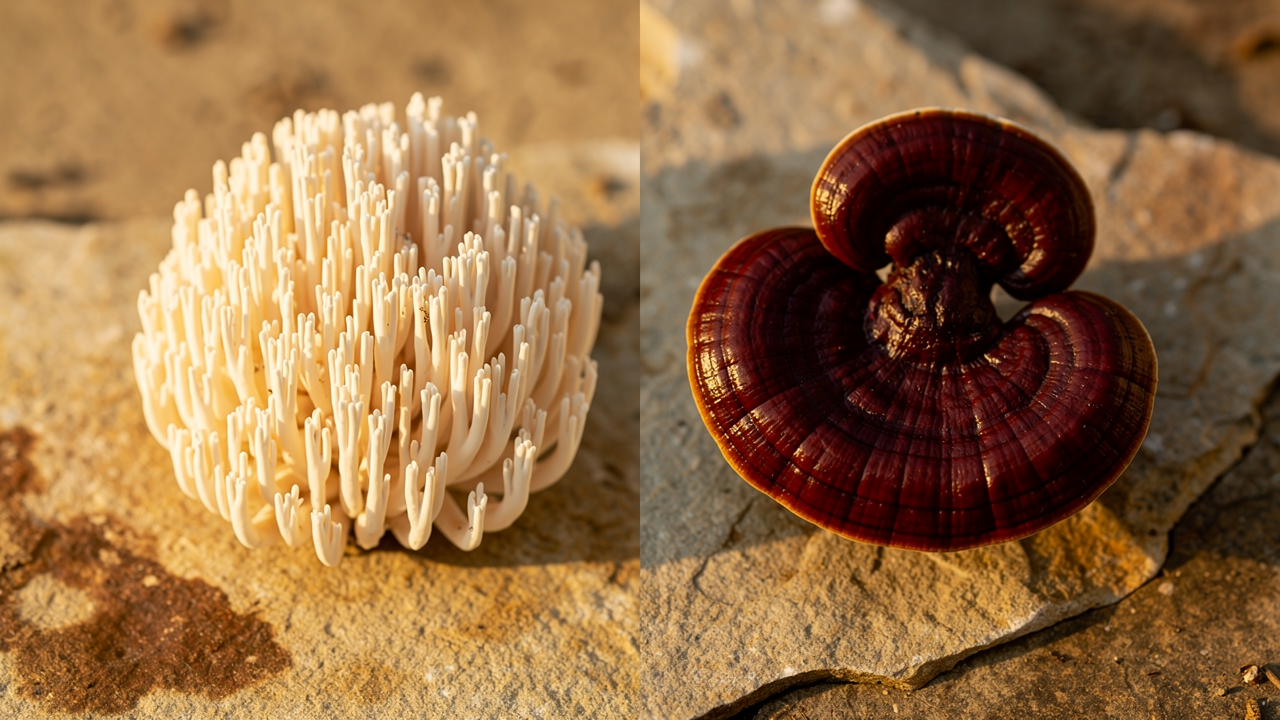
These two mushrooms do not compete. They operate on entirely different systems in the body. Lion's mane (Hericium erinaceus) works primarily on the brain and nervous system. Reishi (Ganoderma lucidum) works primarily on the immune system, stress response, and recovery. Choosing between them is like choosing between a scalpel and a shield — the right answer depends entirely on what you are trying to solve.
This guide compares both mushrooms using published preliminary research. I will cover their mechanisms, what the research actually says, how they are best used, and — for those who want both — how to stack them intelligently.
Understanding the Fundamental Difference
Both lion's mane and reishi are medicinal fungi with thousands of years of use in East Asian traditional medicine. Both are rich in beta-glucan polysaccharides. Both require dual extraction to unlock their full bioactive profile. But their primary mechanisms of action point in very different directions.
Lion's mane's most distinctive compounds are hericenones (found in the fruiting body) and erinacines (concentrated in the mycelium). These small molecules are capable of crossing the blood-brain barrier and stimulating the synthesis of nerve growth factor (NGF) — a protein essential for the growth, maintenance, and survival of neurons. No other commonly consumed food or supplement has this specific mechanism.
Reishi's distinguishing compounds are triterpenes (specifically ganoderic acids) and a diverse array of beta-glucan polysaccharides. The triterpenes are responsible for reishi's characteristic bitter taste and its anti-inflammatory, hepatoprotective, and adaptogenic properties. The polysaccharides are potent immune modulators — activating natural killer cells, macrophages, and dendritic cells to prime immune readiness without overstimulating the system.
Neither mechanism is superior. They address different needs.
Lion's Mane: The Cognitive Specialist
Lion's mane has attracted intense scientific interest because of what it does to the brain. The NGF-stimulating mechanism, first identified in preclinical work, is now supported by a growing body of human evidence — including several recent, well-designed randomised controlled trials.
What the Research Shows
The 2023 double-blind RCT by Docherty et al. (PMID: 38004235, Nutrients, n=41) is one of the most-cited human studies. Healthy adults aged 18–45 received 1.8g of lion's mane extract daily or a placebo for 28 days. The lion's mane group performed significantly faster on the Stroop task — a validated measure of processing speed and cognitive control — at 60 minutes after the first dose. A trend toward reduced subjective stress was observed after 28 days of supplementation.
A 2025 RCT (PMID: 40276537, Frontiers in Nutrition) used a crossover design in 18 healthy adults aged 18–35 who received a single acute dose of 3g of a 10:1 lion's mane fruiting body extract. While the primary composite cognitive outcome did not reach significance, the pegboard test — a measure of fine motor speed and psychomotor function — showed significant improvement, consistent with enhanced neural processing speed.
The foundational Japanese RCT by Mori et al. (PMID: 18844328, Phytotherapy Research, n=30) evaluated lion's mane over 16 weeks in adults aged 50–80 with mild cognitive impairment. The lion's mane group showed significantly higher cognitive scores on the Hasegawa Dementia Scale at weeks 8, 12, and 16 compared to placebo. Crucially, scores declined back toward baseline four weeks after supplementation ceased — suggesting the cognitive benefit requires ongoing intake.
A 2026 mechanistic review (PMID: 41683696, International Journal of Molecular Sciences) synthesised the evidence for erinacines and hericenones, proposing they modulate neurotrophic gene expression via non-coding RNA networks — including regulation of NGF, BDNF, and pathways governing neurogenesis and synaptic plasticity.
Primary Benefits Supported by Evidence
- Processing speed and cognitive control (Stroop task — PMID: 38004235)
- Psychomotor function (pegboard test — PMID: 40276537)
- Cognitive scores in mild cognitive impairment (PMID: 18844328)
- Subjective stress reduction (trend, 28-day supplementation)
- Neuroprotection via NGF and BDNF upregulation (PMID: 41683696)
What Lion's Mane Does Not Do (At Current Evidence Levels)
Lion's mane is not a stimulant. It does not produce an immediate caffeine-like alertness effect. Its cognitive benefits appear to build with consistent use and are most pronounced in populations with cognitive compromise or elevated stress. The 2025 RCT did not find a significant effect on composite global cognitive function from a single acute dose in healthy young adults — a useful calibration on realistic expectations.
Reishi: The Immune and Stress Modulator
Reishi has the deepest traditional roots of any medicinal mushroom. It has been documented in Chinese materia medica for over 2,000 years, referenced in the Shennong Ben Cao Jing — the earliest Chinese pharmacopoeia — as a superior-grade tonic for longevity and vitality. Modern science has spent decades unpacking why.
Immune Modulation
Reishi's polysaccharides — particularly its beta-1,3 and beta-1,6 glucans — activate innate immune cells through pattern recognition receptors including Dectin-1 and TLR-2. This produces what immunologists describe as trained immunity: a primed, responsive immune state without the chronic overactivation associated with autoimmune conditions.
A landmark study by Zhang et al. (PMID: 18048435, British Journal of Sports Medicine, n=40) examined reishi supplementation in elite football players undergoing physiological stress. Athletes who received 20 capsules of Ganoderma lucidum daily showed better maintenance of their CD4+/CD8+ ratio — a key marker of immune balance — compared to placebo during a 28-day high-altitude training protocol. This immune-preserving effect under physiological stress aligns precisely with reishi's traditional reputation as a recovery tonic.
Adaptogenic and Stress-Modulating Properties
The term "adaptogen" refers to a compound that helps the body maintain homeostasis under stress without causing overstimulation or systemic side effects. Reishi's triterpenes interact with the hypothalamic-pituitary-adrenal (HPA) axis — the body's central stress regulation system — to modulate cortisol response and promote a calm, steady physiological state.
This is the primary mechanism behind reishi's well-documented association with improved sleep quality. Regular reishi use, particularly in the evening, supports deeper, more restorative sleep. The effect is distinct from sedation; reishi does not impair alertness the following day. It calms the stress axis, which in turn allows more natural sleep architecture to emerge.
Liver Support
Reishi's ganoderic acids have demonstrated hepatoprotective properties across multiple preclinical models. The liver-supporting properties are a significant part of reishi's traditional use — and for modern users dealing with environmental toxins, processed food, and regular alcohol consumption, this mechanism is increasingly relevant.
Primary Benefits Supported by Evidence
- Immune modulation — CD4+/CD8+ ratio maintenance under stress (PMID: 18048435)
- Natural killer cell, macrophage, and dendritic cell activation
- HPA axis modulation — cortisol and stress response regulation
- Sleep quality support (adaptogenic mechanism)
- Liver support — hepatoprotective via ganoderic acids
- Anti-inflammatory effects — triterpene mechanism
Head-to-Head Comparison
| Factor | Lion's Mane | Reishi |
|---|---|---|
| Primary System | Brain and nervous system | Immune system and stress response |
| Key Bioactives | Hericenones, erinacines, beta-glucans | Ganoderic acids (triterpenes), beta-glucans |
| Primary Mechanism | NGF and BDNF stimulation | Immune modulation, HPA axis regulation |
| Published Studies | ~567 | ~2,379 |
| Human RCTs | 7+ | 18+ |
| Traditional History | ~500 years (East Asia) | 2,000+ years (China) |
| Best For | Focus, memory, mental clarity, neuroprotection | Immune strength, calm, sleep, recovery |
| Onset | Acute effect within hours; builds over weeks | Gradual — most pronounced after 4+ weeks |
| Ideal Timing | Morning (supports daytime cognition) | Evening (calming, sleep-supportive) |
| Taste Profile | Mild, slightly earthy — pairs easily | Distinctly bitter (triterpenes) — needs masking |
| Extraction Required? | Yes — dual extract (water + ethanol) | Yes — dual extract (water + ethanol) |
| Both are complementary — different systems, no known interaction risk | ||
Which Should You Choose?
Can You Take Both Together?
Yes — and this is actually the approach many experienced practitioners recommend. Because lion's mane and reishi target fundamentally different physiological systems, combining them creates complementary rather than redundant coverage. There are no known negative interactions between them.
The simplest protocol is timing-based: lion's mane in the morning to support daytime cognition and processing, reishi in the evening to promote immune modulation, calm, and sleep quality. This aligns each mushroom's primary mechanism with the phase of the day when it is most useful.
Both Teelixir products use dual extraction — a hot water process to liberate beta-glucan polysaccharides, and an ethanol extraction to capture triterpenes and other alcohol-soluble bioactives. This is the only method that captures the full bioactive spectrum of either mushroom. Raw powders or single-extraction products leave significant active content behind.
Dosing and Practical Use
Lion's Mane
Clinical studies have used doses ranging from 1.8g of extract daily (PMID: 38004235) to 3g of 10:1 extract per single dose (PMID: 40276537). For cognitive support in healthy adults, 1–2g of a quality dual extract daily is a reasonable starting point. Teelixir's 10:1 concentration means a standard serve delivers the equivalent of 10g of dry mushroom in a compact dose.
Timing: morning, with or without food. Lion's mane blends well into coffee, smoothies, or warm oat milk. Its mild, slightly earthy flavour is unobtrusive and does not require masking.
Reishi
Clinical research has used a wide range of doses. For general wellbeing, immune support, and sleep quality, 1–2g of a dual extract daily is appropriate. Reishi's characteristic bitterness is a quality marker — it reflects the presence of ganoderic acids. Mixing into warm cacao, herbal tea, or a small amount of raw honey makes the taste far more palatable.
Timing: evening, to align with its calming and sleep-supportive effects. Most people take reishi 30–60 minutes before bed.
Both Together
A practical daily protocol: lion's mane (1–2g) in your morning beverage, reishi (1–2g) in a warm evening drink. Continue for at least 8–12 weeks before evaluating outcomes. Medicinal mushrooms are not acute supplements — their benefits accumulate with consistent use and typically plateau after 3–4 months of daily intake.
Sourcing and Quality: What to Look For
Both mushrooms are widely available, but quality varies enormously. Key factors to evaluate before purchasing:
- Fruiting body vs. mycelium on grain: Hericenones (lion's mane) and ganoderic acids (reishi) are concentrated in the fruiting body. Many products use mycelium grown on grain substrates — the final product contains a significant proportion of starch, not mushroom. Both Teelixir products use 100% fruiting body.
- Dual extraction: Hot water alone cannot liberate triterpenes from reishi. An ethanol extraction step is essential. Look for explicit mention of dual extraction on the label or product page.
- Di Tao sourcing: This traditional concept refers to sourcing from the specific geographic region where a plant or mushroom evolved — where climate, altitude, soil, and ecosystem produce the highest-concentration bioactive profile. Teelixir sources both lion's mane and reishi from their di tao regions.
- Verified beta-glucan content: A stated and independently verified beta-glucan percentage indicates the manufacturer tests for actual potency. Teelixir lion's mane specifies 31.7% beta-glucans.
- Organic certification: Mushrooms are efficient bio-accumulators — they absorb compounds from their growing environment. Certified organic ensures the absence of heavy metals, pesticide residues, and synthetic contaminants. Both Teelixir mushrooms carry ACO (Australian Certified Organic) certification.
Honest Limitations of the Evidence
No head-to-head clinical trial has directly compared lion's mane and reishi in the same study population. Every comparison in this guide is based on each mushroom's independent evidence base, using different populations, doses, outcome measures, and methodologies. Direct quantitative comparison is inherently imperfect.
Reishi's evidence base is significantly larger (2,379 studies vs 567 for lion's mane) in part because it has been studied for several decades longer and has attracted considerable oncology and immunology research. This does not mean reishi is more effective per se — it reflects a different research history. The mechanistic understanding of lion's mane's NGF pathway is arguably more precisely characterised than reishi's multi-target effects.
As with all supplement research, individual response varies. Extraction quality, dosing, timing, and individual baseline health all influence outcomes.
Teelixir's Medicinal Mushroom Range
Lion's Mane Extract
Dual extract · 10:1 concentration · 31.7% beta-glucan · 100% fruiting body · Di Tao sourced · ACO certified organic
Shop Lion's ManeReishi Extract
Dual extract · 100% fruiting body · Rich in ganoderic acids and beta-glucans · Di Tao sourced · ACO certified organic
Shop ReishiFrequently Asked Questions
Is lion's mane or reishi better for anxiety?
Reishi is the stronger choice for anxiety. Its adaptogenic properties — particularly its influence on the HPA axis and cortisol regulation — directly address the physiological stress response. Lion's mane showed a trend toward reduced subjective stress after 28 days (PMID: 38004235), but this is a secondary finding. For chronic stress or anxiety, start with reishi.
Can I take lion's mane and reishi at the same time?
Yes. There are no known negative interactions. Lion's mane and reishi target different physiological systems, making them genuinely complementary. Lion's mane in the morning and reishi in the evening is a practical and well-regarded protocol.
Which mushroom has more research behind it?
Reishi has approximately 2,379 published studies compared to 567 for lion's mane, reflecting a longer research history. Both have strong evidence profiles and recent high-quality human RCTs. More studies does not automatically mean better outcomes for any individual use case.
Does reishi help with brain function like lion's mane?
Reishi has some neuroprotective evidence via anti-neuroinflammatory mechanisms but does not stimulate NGF synthesis the way lion's mane does. For targeted cognitive support — sharper focus, faster processing, better recall — lion's mane is the more specific tool. Reishi's brain-related benefits are more indirect: reducing chronic stress and improving sleep quality creates conditions in which cognitive function naturally improves.
How long before I notice an effect?
Lion's mane has shown acute effects within 60–90 minutes in some human studies. Chronic benefits — cognitive performance and stress reduction — emerge after 4–8 weeks of daily use. Reishi's effects are typically more gradual, with immune and adaptogenic effects becoming noticeable after 3–6 weeks. Both mushrooms reward consistency over time.
Does the extraction method matter?
Yes — significantly. Beta-glucans are water-soluble and released by hot water extraction. Triterpenes in reishi and certain compounds in lion's mane are alcohol-soluble and require an ethanol extraction step. Single-extraction products leave a significant portion of the bioactive profile behind. Always choose dual-extracted products.
Related Reading
Disclaimer: This article is for informational and educational purposes only and does not constitute medical advice. Therapeutic claims have not been evaluated by the Therapeutic Goods Administration (TGA). Always consult a qualified healthcare professional before starting any new supplement, particularly if you are pregnant, breastfeeding, taking prescription medications, or managing a diagnosed health condition.